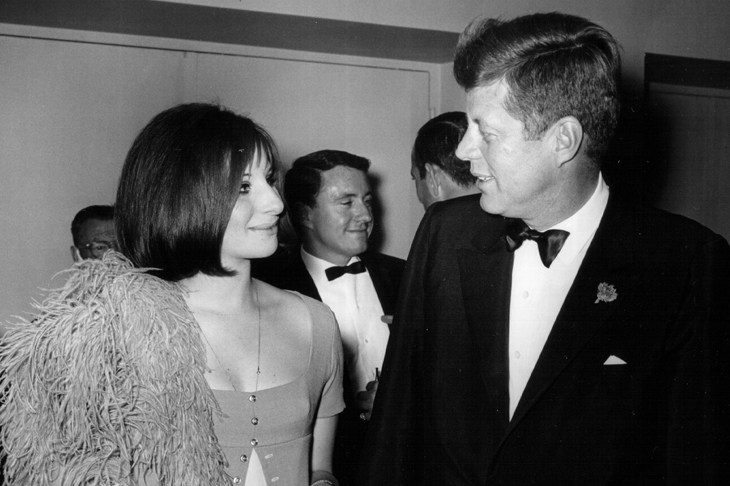
During my first visit to Washington, D.C. in 1985, I stumbled upon a political memorabilia shop in the backblocks of America’s capital city. It was unlike the glossy contemporary stores, more like an old-time bookshop than a modern retail outlet. There were all sorts of wonderful and intriguing items to be discovered as I peroused the narrow shelves, including one particular item that caught my attention. It was a copy of John Fitzgerald Kennedy’s inaugural address, complete with a black-and-white photograph of the 35th President and the inscription, ‘To my fellow sustaining members of the Democratic Party, John F. Kennedy’.
I purchased the printed address including the large envelope in which it had been posted to a supporter. As I recall, it cost $US15.00 – a reasonable amount of money for me at the time. Returning to Australia, I had it framed. It has been displayed, at home and at parliament, for the past four decades.
Occasionally, I have quoted from Kennedy’s inaugural address, one of the most memorable political speeches of the modern era. In particular, I have reminded myself sometimes of his admonition, that ‘civility is not a sign of weakness and sincerity is always subject to proof’.
JFK’s moral clarity came to mind when I re-read his address to the Zionist Convention in New York in August 1960. Just a few months before being elected president, Senator Kennedy said that, ‘Peace is our primary objective in the Middle East.’
‘For Israel was not created in order to disappear – Israel will endure and flourish. It is the child of hope and the home of the brave. It can neither be broken by adversity nor demoralised by success. It carries the shield of democracy and it honours the sword of freedom; and no area of the world has ever had an overabundance of democracy and freedom.’
Reflecting on his visits to the Middle East, Kennedy observed that, ‘Even while fighting for its own survival, Israel had given new hope to the persecuted and new dignity to the pattern of Jewish life.’
‘Some do not agree. Three weeks ago I said in a public statement: “Israel is here to stay.” The next day I was attacked by Cairo radio, rebuking me for my faith in Israel, and quoting this criticism from the Arabic newspaper Al-Gomhouria: “As for the question of the existence and the nonexistence of Israel, Mr Kennedy says that Israel has been created in order to exist. Time will judge between us, Mr Kennedy.”’
‘I agree,’ responded Kennedy. ‘Time will judge whether Israel will continue to exist. But I wish I could be as sure of all my prophecies as I am of my flat prediction that Israel is here to stay.’
It is difficult to envisage how Kennedy would be welcomed into the modern Democratic party. Re-reading his speeches today, they reflect a worldview a far cry from President Biden’s party. As Kennedy indicated, the Democratic party had a special relationship with Israel: ‘Friendship for Israel is not a partisan matter. It is a national commitment. Yet within this tradition of friendship there is a special obligation on the Democratic party. It was President Woodrow Wilson who forecast with prophetic wisdom the creation of a Jewish homeland. It was President Franklin Roosevelt who kept alive the hopes of Jewish redemption during the Nazi terror. It was President Harry Truman who first recognised the new State of Israel and gave it status in world affairs. And may I add that it would be my hope and my pledge to continue this Democratic tradition – and to be worthy of it.’
That same tradition was once proudly claimed by the Australian Labor party. In 1947, the national government of Ben Chifley was one of the first in the world to vote in favour of the UN plan to partition Palestine and recognise Israel. As foreign minister, Herbert Vere Evatt proclaimed that, ‘We remain as steadfast and unwavering as ever in our support for Israel’. That support remained strong in the ALP, especially under Bob Hawke, the first prime minister to visit Israel while in office. Reflecting Kennedy’s commitment, a decade earlier, Hawke warned in 1971, ‘if the bell tolls for Israel, it won’t just toll for Israel, it will toll for all mankind.’
It is true that Hawke seemed to have modified his views somewhat towards the end of his life, but it was to recognise the aspirations of all peoples in the Middle East, not to annihilate the Jews.
While the left – in the US and Australia –have been driven by increasingly totalitarian instincts, something more basic seems to be at play amongst elements of Labor’s right: crude electoral politics. What else explains the muted support for Israel by the Biden administration and the virtual silence on the issue of antisemitism by leading members of the New South Wales Labor right, including Tony Burke, Chris Bowen and Jason Clare? Burke did not condemn the remarks of the preacher in his electorate in the days following their publication. Bowen merely said that he supported the Prime Minister’s position. More recently, Jason Clare claimed he did not know the meaning of the expression ‘from the river to the sea’, a pro-Palestinian chant to wipe out Israel; that is, to eliminate the state of Israel which sits between the Jordan River and the Mediterranean Sea. According to Clare, the statement could mean ‘different things to different groups’.Prime Minister Anthony Albanese was forced to refute Clare’s equivocation, albeit after the failure of the other MPs to condemn antisemitism.
Many people will conclude that the government was happy to allow the equivocation to run, especially in local electorates with large Muslim populations. The Muslim population of a number of seats is significant. Bowen’s seat of McMahon has 14 per cent Muslims; Burke’s seat of Watson has 25 per cent and Clare’s seat of Blaxland has 32 per cent according to the Muslim Votes Matter website.
Sadly, John Fitzgerald Kennedy’s moral clarity has gone missing in a fog of equivocation and denial.
Got something to add? Join the discussion and comment below.
You might disagree with half of it, but you’ll enjoy reading all of it. Try your first month for free, then just $2 a week for the remainder of your first year.