For the last few months, China’s People’s Liberation Army forces have harassed Taiwan, repeatedly breaching the country’s air zone and flying across the midline of the waters separating the two nations.
While incursions have been going on for some years now, the election of Lai Ching-te as Taiwan’s new president has resulted in more aggression from the Chinese Communist party. The Beijing regime warned the Taiwanese people about voting for the Democratic Progressive party candidate and is clearly angered that the nation of 24 million people defied its wishes. The military incursions will continue, especially around the inauguration of the new president on 20 May.
Taiwan is not the lone subject of Chinese enmity. There have been sporadic conflicts in the Himalayas where China has attempted to claim territory from India. Missiles have been fired into Japanese waters and threats made to other nations. While a possible assault on Taiwan remains at the forefront of global attention, another flashpoint has emerged in the South China Sea, namely conflict with the Philippines.
The disputation between China and the Philippines has been brewing for more than a decade.
Former president Rodrigo Duterte had pursued a pro-China approach, distancing his country from the US, despite a security pact between the two nations.
Upon election to office, the current President, Ferdinand Marcos Jr has reversed that stance, clearly positioning the Philippines with the US. Marcos has said that he would not allow ‘a single millimetre of [the Philippines] maritime coastal rights to be trampled upon’. In his 2022 State of the Nation address, Marcos reiterated this stance, stating that he would not cede even one square inch of Philippine territory to a foreign power.
He has maintained the Visiting Forces Agreement with the US. In turn, US Defense Secretary Lloyd Austin has made clear that the scope of the US-Philippines Mutual Defence Treaty extends to Philippines armed forces, public vessels and aircraft in the South China Sea. The Philippines has allowed US forces to use four new military bases, in addition to the existing five already in operation. Three of these bases are in the north of the Philippines, adjacent to Taiwan.
While the Philippines and China continue to discuss economic cooperation, the Manila-based government is strengthening its defences against the CCP regime.
Manila’s wariness is well founded, especially about China’s historically novel claims to sovereign rights over the South China Sea. The claim is based largely on one recently discovered chart depicting the so-called nine-dash line (sometimes also known as the 11-dash line) which the Chinese government suggests – without specific detail – indicates its area of sovereignty.
In 2016, an international tribunal concluded that China had not exercised exclusive control over the waters within the nine-dash line historically and had ‘no legal basis’ to claim ‘historic rights’ to the resources there. It also concluded that China’s historic rights claims over the maritime areas (as opposed to land masses and territorial waters) inside the nine-dash line would have no lawful effect beyond that to which it is entitled under the United Nations Convention on the Law of the Sea.
China has continued to ignore that ruling, instead building a series of artificial islands in the South China Sea, while claiming other reefs and islands that have historically belonged to other nations such as the Philippines and Vietnam. This has led to a series of disputes and physical confrontations in the region.
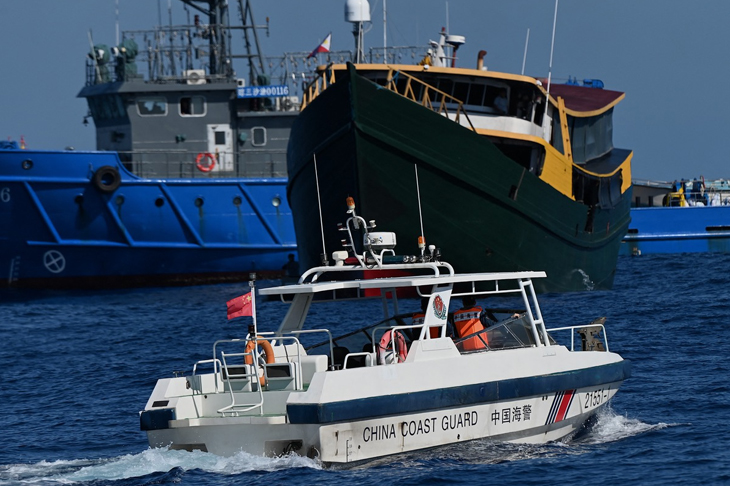
Two years ago, the Chinese Coast Guard blocked a Philippines government vessel attempting to resupply its outpost on the Second Thomas Shoal. In early 2023, another Chinese Coast Guard vessel shone a military-grade laser at the crew of a Philippine Coast Guard vessel on a resupply mission.
Just two weeks ago, another Chinese Coast Guard vessel damaged two Philippine vessels en route to the Scarborough Shoal. According to the Marcos government, this was the twentieth such incident this year alone.
As a consequence of China’s continuing aggression, cooperation with the US has strengthened. Lloyd Austin said recently that an armed attack on the Philippines Coast Guard in the South China Sea would invoke US mutual defence commitments under the Mutual Defence Treaty.
Chinese aggression has also resulted in greater military cooperation between other nations, including Japan and Australia, with joint patrols in the South China Sea.
While neither the US nor the Philippines wish to invoke the Mutual Defence Treaty, there is an increasing danger that China’s actions will cause a military incident. To date Xi Jinping’s regime has shown no signs of altering its dangerous course.
It seems the only playbook that the Chinese government knows is coercion. Having ultilised force and intimidation to successfully control the Chinese people, Xi’s regime believes that it can use the same approach to international affairs. Hence the ‘wolf warrior’ diplomacy, the demands such as the fourteen made to Australia, and its aggression in the region.
Instead of intimidating other countries, China’s actions are uniting them. Even nations that have long been wary of each other, such as Japan and South Korea, are now discussing the common threats to peace and security in the region. Containment of China – once denied – is now openly acknowledged. Most countries in the region are increasing their defence expenditure. Japan, for example, is almost doubling its defence funding.
These are positive signs, but the real danger remains. Given the recklessness – if not the actual intention – of Beijing to use force, the chances of misadventure sprouting greater conflict are significant. History is replete with instances of war breaking out because of misplaced overconfidence by one adversary. As George Santayana said and Churchill repeated, ‘Those that fail to learn from history are doomed to repeat it’. Even Xi Jinping’s ideological hero, Karl Marx, noted the tendency of history to repeat itself.
China’s aggression towards other nations is not confined to the Philippines. Australian aircraft and naval vessels have also been targets of it, along with the military assets of other nations. The identity of the aggressor is clear in all these incidents, despite ongoing denials by Beijing. China is engaged in acts of force, contrary to international laws.
The Philippines flashpoint could spark a wider confrontation in the region if the PLA continues its aggression. It is an outcome that all but one nation in the region are endeavouring to avoid, but the risk remains. It is another reason why Australia should raise its defence expenditure to three per cent of GDP and obtain new military equipment as a matter of urgency.
Got something to add? Join the discussion and comment below.
You might disagree with half of it, but you’ll enjoy reading all of it. Try your first month for free, then just $2 a week for the remainder of your first year.