You will have seen many times, perhaps too many many times, members of the Socialist Workers party, the Refugee Action Coalition, and other similar groups strutting up and down outside government buildings waving placards saying ‘Refugees are welcome here’. I agree with almost none of the policies of left-wing fringe activist groups but I do strongly agree that refugees are welcome in Australia. Where we part company is, given that we cannot take all of the 100 million people under United Nations protection, or the 32 million refugees living in wretched camps around the globe, who should be welcomed?
According to the refugee activists, the answer to this question is ‘almost anyone who can get here’, and their generosity is supported by a growing number of organisations in the refugee industry. If Amnesty International has your email address you will have recently received an email from Zaki Haidari, a ‘Refugee rights campaigner with Amnesty’, asking for a donation to support their cause. Zaki is a former resident of Afghanistan who fled that benighted country after his brother and cousin were murdered by the Taleban. I do not doubt the legitimacy of his claim to refugee status and I accept that he will be a worthy member of our society.
Nevertheless, in Zaki’s letter, he tells us that, ‘Those who do make it into the country are caught up in a cruel system where even today people are still held in offshore detention centres, incarcerated just for seeking protection. And those like me, who are allowed into the mainland, are trapped in endless limbo with no work or study rights’. In other words, Zaki jumped the queue. We know this because those who are granted refugee status offshore, obtain full work and study rights when they do arrive and therein lies the problem.
Zaki doesn’t go into how he got to Australia but it is almost certain that he had to use the services of a people smuggler. By so doing, he may have saved his life, but he also supported the corrupt global network of people who make a living out of desperate people.
In a 2013 publication, the United Nations Office on Drugs and Crime (UNODC) examined the composition of fees paid for smuggling from Afghanistan to Australia through Indonesia. It found that, ‘on average, US$4,000 was paid to an organiser in Afghanistan, US$400 for fraudulent documents, US$2,500 for bribes to law enforcement and border officials, US$700 for logistical costs relating to air travel, US$1,700 for a smuggler in Malaysia and US$3,000 for a smuggler in Indonesia’. No one knows how much money is being paid today to people smugglers globally and the degree of uncertainty about the amount is indicated by estimates from various ‘expert bodies’ which range from $US10 billion to $US150 billion annually.
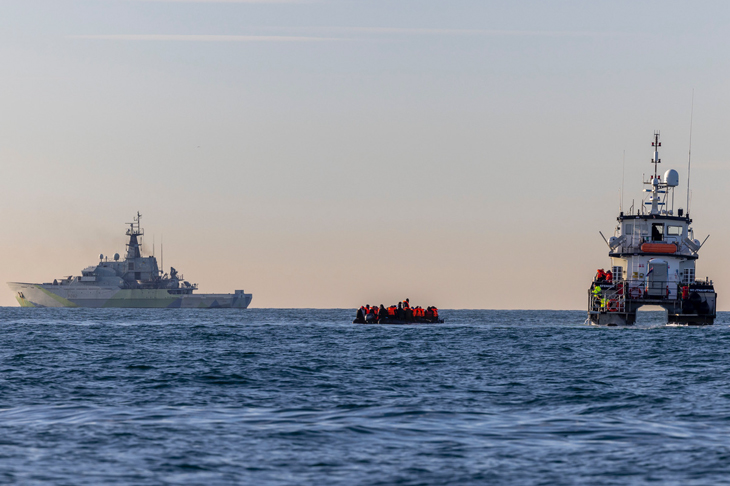
What can be said with certainty is that people smuggling will continue to be a profitable business into the future because it is aided and abetted by a wide range of powerful organisations throughout the Western democracies. Most obvious are the charities such as Save the Children, Médecins Sans Frontières and the advocate groups such as the Refugee Council of Australia. MSF is only one of several charities which have boats cruising around the Mediterranean to pick up people trying to get from Africa to Europe in overcrowded and unseaworthy vessels.
Then there is the legal profession which for a number of decades has been a major beneficiary of business generated by shonky, taxpayer-funded refugee applications. As Paul Sheehan noted over a decade ago, ‘Ideological lawfare is now clogging the entire legal system in the name of refugee rights. The people enmeshed in this campaign against parliament range from the Chief Justice of the High Court to the ideologues toiling in the lower courts and refugee tribunals.’ That particular justice has now retired but judicial activism is alive and well. Witness the wholehearted support various legal luminaries are offering for the Voice campaign.
And we must not overlook our friends at the ABC and SBS who have been known to produce the occasional story about the inhumane treatment of people in offshore detention centres while ignoring the fact that those centres were made necessary by the creative misuse of the legal system to prevent the removal of people whose applications for refugee status were rejected.
However, for me, the hypocrisy of our own refugee activists pales into insignificance when compared to the pious nonsense produced by the United Nations.
In 2021, 47 UN-member states raised concerns about the Australian government’s treatment of refugees as part of a five-yearly review. That great defender of human rights, the Russian Federation, was ‘concerned by the illegal migrant centres on the islands of Manus and Nauru. Migrants are held there for years without court decision and there have been reports of suicide attempts, including among minors’.
The Iranian government suggested that we should, ‘End the mandatory detention of refugees and prohibit offshore processing of asylum seekers’. Iranian and Russian governments routinely murder their own citizens and allowing their officials to comment on Australia’s refugee policies under the imprimatur of the UN is an obscenity.
In a report published by the IPA last year, – Who Gets To Stay? Refugees, Asylum Seekers and Unauthorised Arrivals in Australia – Tess Rod and Ron Brunton wrote; ‘it is now widely recognised that the fifty-year-old (Refugee) Convention is no longer working effectively in the face of mass movements of people from the Third World. People-smuggling has grown in recent years to become a $10 billion a year industry. Western countries are currently expending a similar amount in attempts to deter these racketeers and to process claims for asylum from their clients who have been apprehended by authorities. Not only does this compromise the original intention of the Refugee Convention, but it also, unfortunately, diverts funding and resources for assisting refugees in overseas camps as countries cope with domestic problems caused by inflows of illegal immigrants’.
Australia has a proud record of assimilating millions of refugees and migrants into a cohesive, stable and prosperous nation and we should continue to do so. But the moral bankruptcy of the political left and the UN has destroyed the important distinction between refugees and people seeking a better life in prosperous democracies. It is time we had an honest look at our support for the UN.
Got something to add? Join the discussion and comment below.
You might disagree with half of it, but you’ll enjoy reading all of it. Try your first month for free, then just $2 a week for the remainder of your first year.