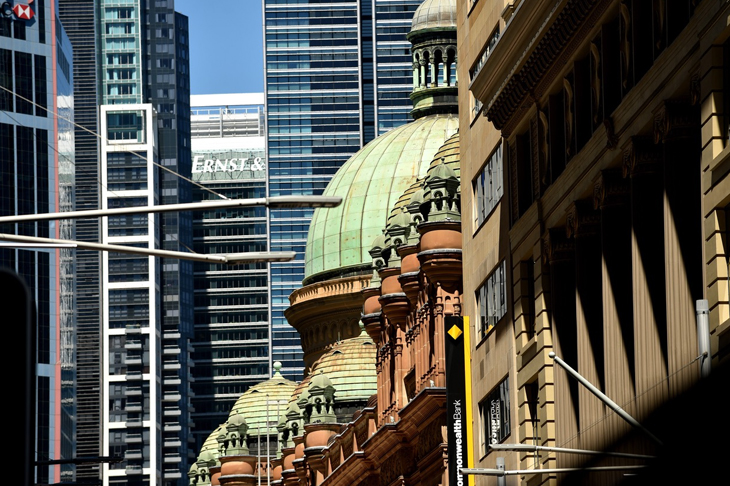
How many Australians are aware that, were it not for Barry Humphries, the great glory of Sydney’s George Street, the Queen Victoria Building (QVB), would have become a car park? Humphries’s obituaries have disappointingly overlooked several important aspects of the great Australian’s life.
For example, where is the acknowledgement that the Department of Foreign Affairs was instrumental, according to Peter Cook, in promoting Humphries’s career? Cook claimed that in the early 1970s he once arrived with Humphries at Australia House in London for a reception. When they spoke to a ‘rough diamond’ Australian consular official, Humphries, to Cook’s surprise, encouraged the man to continue to speak at length, studying him intently, and then rushed off and wrote copious notes. Thus was Sir Les Patterson born.
Also overlooked has been Humphries’s passion for old Australian architecture and his heroic activism to save many threatened treasures. In this area, as in relation to politics generally, he was undoubtedly a traditionalist and conservative.
That can’t be said definitively about all his social and cultural views. Much of the humour of his characters, initially at least, was based on lampooning the dull provincial stodginess of the Melbourne of his youth. And the riotous dadaist antics of his younger years and lifelong fascination with the early 20th century avant-garde in music and art, together with his hatred of sport, don’t make him a neat fit into the role of cultural conservative. At the same time, for all his irritation with the social conservatism of Melbourne suburban life of his youth, he was never a real fan of modernism in any of the arts. He didn’t like abstract painting and, indeed, once said his favourite artist was the widely popular Heidelberg School impressionist Charles Conder, whose evocative figurative pictures of late-colonial Australia are a long way from anti-establishment modernism. Humphries at one time had the world’s largest private collection of his works.
On matters of sexuality, much of the time he played the role of stirrer, forever retaining an irrepressible bohemian desire to scandalise polite opinion – ‘I think I’m infrasexual – in for any sex that’s going’, he answered in response to a question in 1978 at the National Press Club. But then around the same time he responded to a request from Geelong Grammar School for a contribution for the construction of a tennis court for one of its girls’ houses by referring to the ‘dangers of encouraging tennis’, underlined by Billie-Jean King’s disclosure that tennis ‘contributed to her grievous sexual disorder’. (He added that he would always be happy to make a generous contribution to any proposal to dismantle the school’s sporting facilities). But of course none of this contrarianism mattered to the grim-faced ideologues in charge of the Melbourne ‘Comedy Festival’, who accused him of being a right-wing bigot because he deviated from the latest woke pieties on transgenderism.
Politically, he was certainly a conservative, serving for many years on the board of Quadrant and describing one of his hobbies in Who’s Who in Australia as ‘baiting humourless republicans’. Sir Les was initially conceived as an international arts envoy of the Whitlam government and poked much fun at it. More recently, Humphries scandalised the wokerati with his comment on Trump: ‘I’m grateful to Trump for stirring up politics. And I won’t be joining any marches against him.’ His ‘heretical’ confession in My Life as Me that he in some ways preferred Prague under communist rule can safely be treated as one of his mischievous provocations.
When it came to architecture, Humphries was consistently conservative and absolutely clear about his views, loathing the brutalist concrete modernism – ‘the disastrous influence of Le Corbusier’, as he wrote – which in the 1950s started encroaching on Australia’s pre-World War II architecture which he grew up with and loved. He reserved some of his most savage criticism for the authorities who were embarrassed by Melbourne’s Victorian architecture as the 1956 Olympics approached and presided over an orgy of demolition of many magnificent buildings out of a philistine fear that the city would seem ‘old-fashioned’ to foreign eyes. In addition, ‘whole districts of bluestone terraces were wiped out in the name of slum clearance so that the Housing Commission could erect the high-rise slums which still disfigure Fitzroy and North Melbourne’, he wrote. He was angered by the 1979 demolition of Brisbane’s magnificent colonial-era Bellevue Hotel and the replacement of many of Sydney’s original sandstone harbourside villas with characterless post-war blocks.
He first became a conservationist activist in the early 1970s in opposition to the plans to demolish the QVB. These plans were strongly backed by modernist architect Harry Seidler, who called the building ‘a monstrosity’. The episode prompted Humphries to develop a particular contempt for Seidler, who wanted to demolish Sydney’s colonial-era architecture in favour of lots of Blues Point Towers.
Numerous Australian architectural treasures threatened with demolition or redevelopment in addition to the QVB owe their survival at least in part to Humphries’s activism. They include Melbourne’s Queen Victoria Market and Edwardian tram shelters, Camberwell railway station, Flinders Street Station, Victorian terraces in Redfern’s Pitt Street and Parramatta’s art deco Roxy Theatre. Meanwhile he savaged what he saw as modernist abominations, such as Melbourne’s Federation Square, which he said should be bulldozed.
It was no accident that one of Humphries’s closest friends was Britain’s Poet Laureate, writer and broadcaster John Betjeman. Betjeman was a founder of The Victorian Society and a passionate campaigner for the preservation of that era’s architecture in Britain. Just as Humphries played a key role in saving the QVB, we have Betjeman to thank for saving one of London’s great Victorian treasures, St. Pancras Station. Humphries’s love of old buildings was also in line with the views of the King, a life-long fan who spoke to him on the day he died.
Some assume that Humphries’s comic characters reveal a contempt for his native land. This is as absurd as claiming that John Cleese and Warren Mitchell channelled a loathing of Britain through Basil Fawlty and Alf Garnett. Humphries had a deep affection for Australia and nothing underlines this better than one of his great legacies, saving many of our much-loved architectural treasures.
Got something to add? Join the discussion and comment below.
@markhiggie1
You might disagree with half of it, but you’ll enjoy reading all of it. Try your first month for free, then just $2 a week for the remainder of your first year.