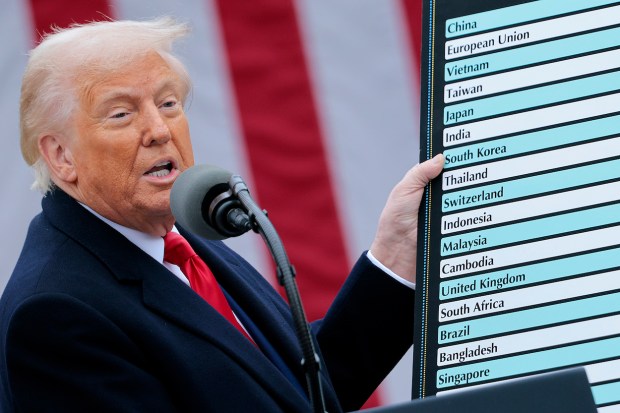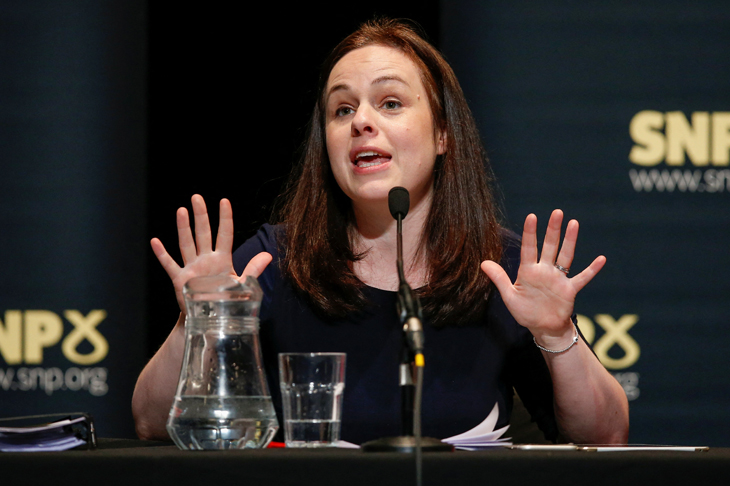
As with Jacinda Ardern, luvvies fell over themselves paying tribute to Scotland’s departing Scottish National party (SNP) leader Nicola Sturgeon – champion of ‘marginalised minorities’, committed advocate of climate change action, etc. Donald Trump by contrast in his inimitable style spoke for most conservatives: ‘Good riddance to failed woke extremist Nicola Sturgeon…. This crazed leftist symbolises everything wrong with identity politics.’
Sturgeon’s departure was expected but has thrown up surprises. Firstly, a key factor prompting her resignation was British Prime Minister Rishi Sunak showing rare conservative spine in vetoing her gender recognition reform (GRR) bill – allowing self-identity for those as young as 16 – as inconsistent with UK law. That followed the UK Supreme Court quashing Sturgeon’s hopes to stage a further independence referendum unilaterally – and polling showing it would probably fail again. The final humiliation was being pressured into backing down after her judicial system placed a wigged rapist in a women’s prison because he claimed to identify as a woman.
The next surprise was that the SNP – whose members generally appear to be woke evangelists as well as anti-English obsessives – was revealed as containing within its senior ranks a Christian social conservative, Kate Forbes, who has emerged as one of the two serious contenders to succeed Sturgeon. Her church, the fundamentalist Free Church of Scotland, succeeded until recently in banning ferry services and lawn-mowing on Sundays. Astonishingly for the right-on world of the SNP, after Forbes announced her candidacy for the leadership, she said she wouldn’t have voted for same-sex marriage or the gender recognition reform bill. She also opposes abortion and children being born outside wedlock. The equivalent in Australia would be learning that a Greens Senator is a member of the Australian Monarchist League or provides editorial advice to Sky’s Outsiders. Unlike the ‘continuity candidate’ for the leadership, Health Secretary Humza Yousaf, Forbes has said she’d be ‘loath’ to mount a legal challenge to Westminster’s vetoing of the GRR bill. But she’s committed to not rolling back current gender rights. The Sturgeonites ignore that and scream that a Forbes win would represent a shift to the right and could split the party. The Greens have added pressure on the SNP’s 78,000 members, now voting to decide the new leader by 27 March, by threatening that a Forbes win would end the coalition agreement that provides the SNP with a parliamentary majority.
The process of replacing the First Minister was supposed to be boring and predictable. Sturgeon and her loyalists expected an unmessy crowning of Yousaf. However, probably unwisely, he’s the only one of the leadership candidates who says he’ll mount a legal challenge for the blocked GRR bill – opposed by two-thirds of Scots. Other headwinds Yousaf has encountered include his grim ministerial record: trains never on time when he was transport minister, plus, on his current health watch, hospital waiting-times longer than even England’s, ambulances taking an average six hours to arrive and drug deaths the worst in the developed world. There’s also suspicion of him outside metropolitan liberal circles for an infamous rant complaining about non-whites not being in enough positions of power in Scotland. And there are questions over his honesty. He claims he couldn’t make the final vote on the GRR bill because of a prior engagement – which, it turns out, was arranged after the date of the vote was known. A Muslim, he was reportedly under pressure from the mosques not to vote for the bill. In an entertaining twist, Scotland’s imams have been reported as criticising Yousaf on morality and gender issues and suggesting that they’d prefer Forbes.
Yousaf was the earlier favourite, but the momentum now seems to be with Forbes. The latest polls among SNP members put her a few points ahead. Polling of all Scottish voters show Forbes with a stronger lead: 33 per cent to Yousaf’s 18 per cent. Though 36 per cent are still undecided, the trend is towards Forbes. Another factor in Forbes’s favour is that under the SNP leadership preferential voting system, she’s likely to pick up much of the vote (currently around 10 per cent) for Ash Regan, the third candidate, who is expected to drop out. Forbes’s momentum, suggesting that Scotland is a more conservative place than the SNP leadership imagined, is said to be generating panic at party headquarters.
Forbes stands for a radical change of SNP direction – she says that ‘more of the same’ is ‘an acceptance of mediocrity’. Her priority would be to revive the stagnant economy through better relations with business, to improve services, especially health, and to de-emphasise identity politics. The Gaelic-speaking, Cambridge-educated Forbes is widely seen as more competent and talented than Yousaf and comes across as thoughtful, moderate and likeable. UK Spectator editor Fraser Nelson calls her ‘perhaps the smartest woman in Holyrood’. But while conservatives for obvious reasons in many ways would like to see her prevail, she’s no less signed up to the crazy goal of tearing Scotland out of the UK than the other leadership contenders – even if she advocates a more gradual approach than her party’s current leadership.
Over the past two years, most opinion polls show support for independence softer than the 45 per cent achieved at the 2014 referendum, with some showing it as low as 37 per cent. Brexit makes an independent Scotland in the EU more complicated – a hard border with England, where 60 per cent of Scottish exports go, would probably be needed. And the SNP’s drift to the Green-Left means it no longer argues that North Sea oil and gas could make Scotland a richer energy superpower.
Forbes is unlikely to change that but her intelligence and competence would probably make her more successful than the current SNP establishment in building support for independence beyond its current mainly metropolitan left-liberal base. That could over time put irresistable pressure on London to agree to another referendum. To prevent the awful prospect of the separation of England and Scotland – probably the world’s most successful international partnership since their unification in 1707 – it would be preferable if the SNP remained under the control of the party’s shambolic wokerati.
Got something to add? Join the discussion and comment below.
@markhiggie1
You might disagree with half of it, but you’ll enjoy reading all of it. Try your first month for free, then just $2 a week for the remainder of your first year.