Mining giant and Fortescue Metal executive chairman Andrew Forrest said at a Sydney conference this week:
‘We are fat and happy and have a relatively good lifestyle, but the rest of the world is changing very fast.’
Speak for yourself!
They were comments made by Mr Forrest urging Australia to further invest in so-called ‘green’ energy, and more specifically, green hydrogen – a technology which never takes off due to its numerous shortcomings.
‘We will miss a one-off opportunity (to become involved in green hydrogen) if we don’t move. The scale of the opportunity is massive.’
The pitch was aimed at the rivers of gold on offer from the (broke?) Biden government. Bumbling around in fits of insanity like the man himself, the regime is trying to tackle inflation by throwing billions at anything with the word ‘green’ in the title. It’s no wonder the sharks are circling.
Meanwhile, the average Australian has watched the green revolution destroy their quality of life while enriching plenty of executives, bureaucrats, politicians, and mining companies.
The Earth has never been torn apart faster than it is in 2023, but don’t worry, those bulldozers are doing ‘Greta’s work’, saving the planet one vat of sulphuric acid at a time. Energy prices have doubled in Western nations under the burden of solar, wind, and battery expansion. Filling up the family car has become a luxury, while unsympathetic Woke councils have told the poor to ‘walk’ or ‘ride a bike’. Those who claim to care about the aged care crisis seem rather unsympathetic toward pensioners sitting in dark homes, shivering under a motionless air conditioner.
As for being ‘fat’, food prices have risen so high that even the public broadcaster has noticed families skipping meals and the European Union is discussing making food cheaper by cutting flour with crushed up bugs.
Is ‘green’ energy profitable without public money? Almost certainly not. If the government were to sever the umbilical cord and force investors to use their own money without grants and incentives, we’d see panic spread through the green industry. They are chasing lucrative handouts, not technological developments. We are incentivising endless research in the same way the university system steals the youth for ten years, lured by mindless Arts degrees.
Any industry kept alive by acting as a parasite of the taxpayer is not creating a sustainable future. Which brings us to the morality of offering the richest people in Australia handouts.
Andrew Forrest is reported to be worth US$19.8 billion, so it is with some surprise that we read he is accepting a partially taxpayer-funded partnership with Federal Environment and Water Minister Tanya Plibersek.
This may be an example of the government brandishing cash fresh from the printing press – but it should be rejected as a matter of principle.
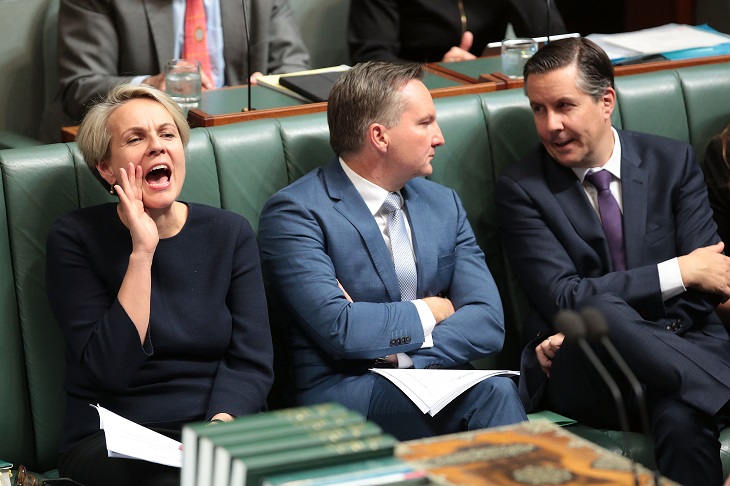
Plibersek is having a hard time keeping the Greens, Teals, and brainwashed Labor youth happy as the reality of the green revolution crashes into her ministry. Labor has to keep the lights on, and that means approving projects at odds with their election campaign.
For example, Plibersek was forced to ignore those who tried to block a $4.5 billion fertiliser plant despite the proposal ‘impacting ancient Indigenous rock art’. The official voices in the local Indigenous community want it to go ahead. She’s now in a mess, especially after the federal government nominated the area for a World Heritage listing and was quickly smacked down by the Murujuga Aboriginal corporation as being ‘deeply hypocritical’. Which Indigenous voices does Plibersek listen to? The ones that want the development to go ahead or those that want to protect the rock art? The answer is probably a cynical, ‘whichever voices serve the government’s interests’.
Labor have also been forced to approve large coal and gas reserves despite protests from the Greens who said:
‘Labor seems desperate to open up new coal and gas while they can. The Greens will continue negotiations, but Labor seems to want new coal and gas mines more than they want their safeguards mechanism.’
With Faruqui adding: ‘Labor is making the climate crisis worse. This is why we need to change the law to stop new coal and gas mines.’
Evidently, the Greens haven’t received the memo pointing out that without coal and gas expansion there is no ‘green energy grid’.
Smoothing over this bumpy reality, Plibersek and Labor have made Australia a founding member of the Forests and Climate Leaders Partnership launched at COP27 in Egypt which includes all kinds of scary stuff, like the Glasgow Leaders’ Declaration on Forests and Land Use to ‘achieve the Paris Agreement and the United Nations Global Forest Goals’.
It doesn’t hurt the Minister of the Environment and Water’s PR to announce a pledge for a national plan to manage ocean health – despite Australia being unable to keep China from fishing endangered species inside our Antarctic territory. Essentially, it’s a way to pretend the government is doing something so that it can avoid doing the difficult things – like chasing Chinese military vessels away from penguins.
Plibersek’s lauded announcement about the ‘sustainable ocean plan’ isn’t as inclusive as it likes to think.
‘That means industry and scientists and conservationists and traditional owners, all together, all in the same room, all contributing to the same conversation,’ said Plibersek. But not the ordinary Australian taxpayer, apparently.
It was at this meeting that Mr Forrest’s philanthropic eDNA cruise around the Western Australian coast was announced.
‘This is a pivotal moment in response to a planetary emergency,’ said Mr Forrest.
Sorry… I think I choked on the hubris.
The project in question involves Mr Forrest’s 58-odd metre superyacht, the Pangaea Ocean Explorer, cruising around island paradises on a research project for the Minderoo Foundation powered by its (evil?) twin diesel Caterpillar (3508 B) 8-cylinder 1,000hp engines.
Australians suffering through a financial crisis are set to toss $3.4 million toward the $11.8 million project. It’s hard to imagine the public feeling this is ‘money well spent’ while a handful of researchers enjoy the luxury cruise and Plibersek grins in front of the nearest camera.
We could discuss the merits of the two-year project – which seeks to collect ‘environmental DNA’ from waters around the Pacific – or we could state the obvious: Mr Forrest does not need public money. He can fund it himself.
The Minderoo Foundation’s OceanOmics project describes the research into eDNA as:
Nucleic acids (DNA and RNA) are the architectural blueprints for all life on Earth. Capturing and analysing these blueprints from pieces of DNA or cells found in the environment with genomic tools is the study of environmental DNA (eDNA).
We believe eDNA-based marine genomics and AI can form the technological basis for innovations that will revolutionise how we measure, understand, and ultimately protect life in the ocean.
By developing and deploying these technologies we will characterise and monitor marine wildlife at a pace and level of precision that traditional survey methods cannot achieve.
We have equipped the research vessel, Pangaea Ocean Explorer, with shipboard laboratories containing cutting-edge cellular and molecular biology equipment, including high throughput DNA sequencing instruments and bioinformatics workstations.
We are investing in building and openly publishing the reference libraries for marine vertebrates which are necessary to accurately detect, monitor and determine the health of these species.
When you read further, it becomes clear that this research will then be used to further regulate how citizens engage with the ocean. Although one can safely bet that any additional regulation will be ignored by Chinese fishing vessels, which are responsible for the vast majority of damage to fish stocks – not Australia.
Minderoo Foundation’s commitments include: building momentum for environmental DNA (eDNA)-based fisheries monitoring, lifting standards for flag state regulation to ensure sustainable and responsible distant water fishing operations, developing the Global Fishing Index, catalysing ocean conservation through the Blue Nature Alliance, and expanding our knowledge of the oceans including the deep sea.
More specifically, eDNA is related to the monitoring of fisheries. As stated by the Minderoo Foundation on its website:
Building Momentum for a global roll out of eDNA-based fisheries monitoring (A$4.8 million)
The United Nations’ efforts to end overfishing and achieve its Sustainable Development Goals face a challenge in accurately and cost-effectively measuring the population status of marine species on a global scale. This project aims to remove that barrier by using eDNA-based monitoring approaches, building the infrastructure, promoting the approach across the Indo-Pacific region, and providing support for partner country fisheries agencies to pilot eDNA monitoring.
The British Ecological Society describes using eDNA to monitor fish markets. It claims that this will be used to get a handle on the enormous un-monitored markets of Asia, Africa, and the Pacific – but one might point out the obvious: if these fish markets can’t obey basic monitoring, the chances that a Medieval-level fish stall in the middle of nowhere is going to submit to eDNA testing is wishful thinking.
It is far more likely that obedient countries like Australia will have their fisheries put under another level of invasive global surveillance while overfishing by neighbouring communist dictatorships continues. Tackling that problem means forcing individuals like Xi Jinping to bring his many provinces under control and find a way to replace the lost revenue of illegally caught fish. That requires significant domestic changes across Asia – not a digital identity system for fish.
According to The Australian, Mr Forrest has ‘long been passionate about the potential of eDNA to deepen the scientific understanding of the world’s oceans’. That’s fantastic. Spend your own money and go crazy with your planet-saving research ambitions.
The better question is, why does Plibersek feel the need to waste our money on the eDNA superyacht research cruise when it’ll happen without the Australian taxpayer? Is it just a bit of million-dollar branding to feather the government’s environmental image? Because there are more pressing environmental issues.
‘It means we could dip a bucket into the water and by the power of science detect if an endangered species has been in the area recently,’ said Plibersek.
From ‘the speed of science’ to ‘the power of science’, we are doing everything except using science to make our lives better.
As one comment on The Australian article says, ‘How about Tanya puts this $3.4 million towards [m]y $275 power bill reduction promised at the last election?’