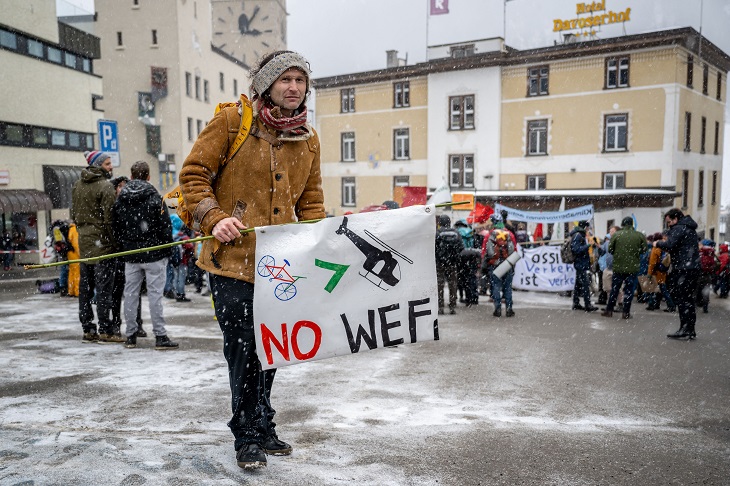
The private jets have landed in Davos for the 2023 Bond villain meeting – sorry – I mean the closed-door lobbying event for today’s global saviours. It is running between the 16-20 of January with the theme of ‘Cooperation in a Fragmented World’ that cheerily warns us, ‘2023’s Global Risks Report expects a decade of disruption, decay, and impossible choices’.
There is something different in the pristine Swiss Alps air this time. It’s a whiff of … irrelevance? A hint that the empire of delusion is finally starting to crumble…
A quick browse through the press coverage in the last few days reveals plenty of less-than-flattering headlines, even from typically hard-left publications.
Davos 2023 hosts global elite amid recession fears, says DW.
Davos’s elite will need to do some soul-searching in a world falling apart, writes The Guardian.
Davos draws record crowds, but its relevance is fading, moans CNN.
The Davos party returns, with the shakes, adds Reuters.
Why are they all so miserable? This is meant to be the highlight of the eco-fascist calendar – a talkfest of celebrities akin to Marvel superheroes!
Perhaps these media outlets have realised that 2023 is also the year where the catastrophic decisions of WEF partners and members are about to come home to roost, soiling Western economies with disastrous consequences.
Whether it is Net Zero, Covid, or Digital Identity – the clutches of tyranny are starting to be felt while global economic strain is eating away at civilisation’s patience for power-hungry globalists who never got the memo from last century that international socialism (which is what we’re actually looking at it) failed miserably.
In addition to 600 CEOs, plenty of mining giants, and 52 government heads, there will be 19 governors from central banks and 56 finance ministers. The guest list accounts for nearly every Wall Street CEO and significant banking industry figure. Wouldn’t you love to see what sort of handshakes they’re making in the shadows?
From Australia, Fortescue CEO Andrew (Twiggy) Forrest, Rio Tinto CEO Jakob Stausholm, and BHP head Mike Henry are all expected to partake in the festivities.
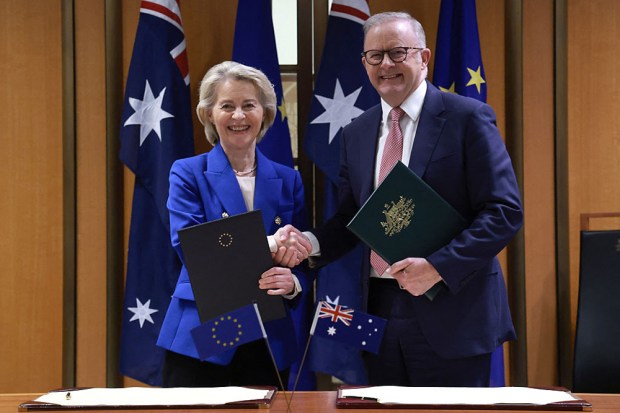
Prime Minister Anthony Albanese won’t be able to make it (which is rather surprising, given he’s got more miles on him than your average albatross), but Tim Ayres will muddle through the crowds on his behalf. He might bump into former Prime Minister Kevin Rudd or OECD Secretary-General Mathias Cormann (who has been flirting with dreaded European carbon border taxes as a way to save the world). US climate envoy John Kerry couldn’t resist attending, nor could (the world’s most powerful woman) European Commission President Ursula von der Leyen.
It’s just as interesting to mention who is conspicuously absent from the Swiss ski resort.
This year you won’t find shouty-activist Greta Thunberg (who was carted off by police a few days ago from a protest at a German coal mine forced to expand to pick up the slack from renewables), UK President and WEF luvvie Rishi Sunak, French President Emmanuel Macron, US President Joe Biden (who probably couldn’t find the right private jet), Russian President Vladimir Putin (who is banned), and Chinese Dictator-for-Life Xi Jinping (who’s finally having to deal with the plague he put the rest of the world through).
WEF founder Klaus Schwab – who dresses and speaks as if he were Blofeld reborn – addressed reporters regarding the Davos conference.
‘Economic, environmental, social, and geopolitical crises are converging and conflating, creating an extremely versatile and uncertain future. The annual meeting at Davos shall try to make sure that leaders do not remain trapped in this crisis mindset.’
WEF President Borge Brende added:
‘There really is a lot at stake when it comes to the global economy to make sure that we avoid a global recession, how to avoid low growth, high inflation, high debt.’
What they neglected to mention is how many of these crises can be linked back to ideas championed by the WEF or initiatives and policies put in place by WEF partners and friendly governments. So far, the commentary surrounding the conference from its participants has been very much a ‘don’t look over there at the raging fire of catastrophe – we’re looking forward to new ways to make money and ruin your life!’ sort of theme.
Social media giants, who were previously very fond of the authoritarian and censorial control fantasied about at Davos, have cut their participation. While not ‘absent’, they’re hardly sitting next to Klaus’ chair like a pet cat. Not only is new Twitter CEO Elon Musk embarrassing a lot of people in the room, Silicon Valley has endured a savage culling. It turns out that abusing users wasn’t the best business decision…
‘I was invited, but declined,’ tweeted Musk, before coming back with a machete. ‘My reason for declining the Davos invitation was not because I thought they were engaged in diabolical scheming, but because it sounded boring.’
While tech giants are tapping out, Davos is courting the business world. They have to do something, because politicians are dropping off too – forced to handle the growing civil outrage caused by WEF ideas. Billionaire CEOs can get away with the hypocrisy of flying private jets to a conference about the ‘climate catastrophe’, but Prime Ministers and Presidents are finding it increasingly difficult to explain their lack of moral consistency.
‘Only personal interaction creates the necessary level of trust, which we need so much in our fractured world,’ defended Klaus Schwab, rather weakly.
The presence of so many CEOs reflects how much money they intend to make from a new range of Net Zero legislation and social manipulation that promises to suffocate the free market and get rid of their competitors, particularly small and medium businesses who have no way to compete against the enormous green lobbying power of billion-dollar companies.
You almost feel sorry for the young protesters outside, rugged up in snow gear believing they’re all about to be killed by an inferno-Earth. They don’t understand why Davos is populated by fossil fuel companies, laughing and joking with ‘green’ governments as they enjoy the largest mining boom (off renewable energy) in modern history.
‘We are demanding concrete and real climate action!’ shouted one of the protesters.
Others insisted, through frosty tears, that these companies ‘immediately stop opening any new oil, gas, or coal extraction sites’ although none of them appear to know that their beloved pharmaceutical industry is almost entirely dependent on fossil fuels.
Which is the problem with kids these days…
The activist community never goes beneath the latest hashtag. If any politician was actually foolish enough to meet their demands, society as we know it would collapse in on itself and they would be the first people screaming for help.
About the only intelligent thing said of the conference so far came from a Professor of International Relations at the Vienna School of International Studies, Markus Kornprobst.
‘It’s basically too simple to say it’s an era of globalisation or an era of deglobalisation. It’s an in-between era.’
Indeed, we are living in an age between conflicts – riding that trough in the open ocean with the world wars of last century behind us and a whole fresh lot of hell waiting to hit.
The largest empires on Earth are pulling away from each other, driven there by the ruthless expansionism of China’s communist dictatorship that has decided to threaten ‘re-unification’ with its neighbours as a means to secure domestic power. Illegally snatching Hong Kong and vandalising its liberty was only the start.
Europe, meanwhile, is suffering the consequences of decades of increasingly socialist-thinking carried out alongside unsustainable mass migration from violently different third-world cultures. Their political systems are breaking, causing the European Union to lash out with idiot ideas like ‘carbon border taxes’ as a last-ditch attempt at protectionism.
Meanwhile, small but crucial powers such as Taiwan are being preyed upon at the same time Pacific powers are choosing to identify as prey in the hope of extorting billions in climate guilt money from failing economies like Australia with naive politicians at the helm, desperate for easy headlines to drown out cost-of-living complaints.
These sorts of problems cannot be solved by a self-interested Davos conference populated by former politicians and CEOs looking to profit off the carcass of humanity.
It’s difficult not to choke upon hearing that Klaus Schwab’s ‘goal’ for Davos this year is to ‘get rid of the crisis mindset’.
Having unleashed the hell of worldwide panic and fear, Davos now wants to bottle that energy toward the profit margins of its CEO mates.
‘Unless the world starts to cooperate more effectively on climate mitigation and climate adaptation, over the next 10 years this will lead to continued global warming and ecological breakdown.’
What was Klaus just saying about ‘getting out of the crisis mindset’?
This week, we’re going to keep an eye on what they’re up to…