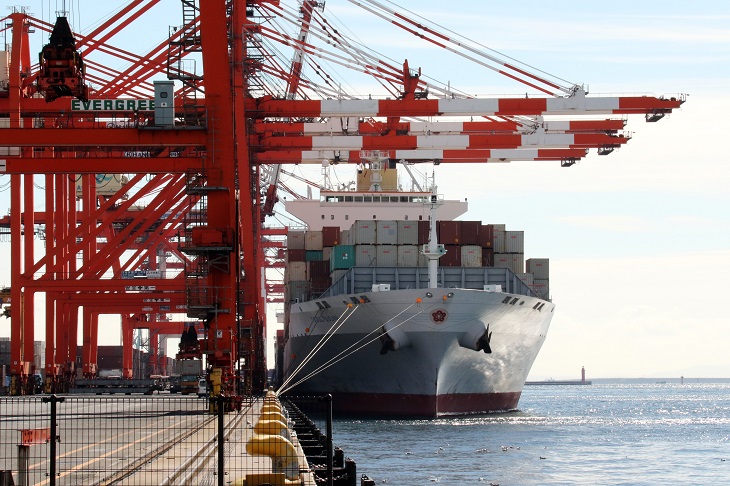
Mitsui OSK Lines, one of the world’s largest shipping companies (with 698 vessels carrying 50.8 million deadweight tons), has re-launched – uh – sailing ships?
Their website spectacularly unveiled the ‘Wind Hunter’, subtitled, Shape the future with wind and hydrogen.
They write:
‘What if we could build a ship that could transport cargo across the globe without needing any fuelling? What if we could make the ultimate zero-emissions seagoing vessel to reduce greenhouse gases?’
Now, I know what you’re thinking… Didn’t Captain Cook navigate a Net Zero transport vessel when he took to the south seas on his first voyage of discovery aboard the HM Endeavour departing from Deptford on July 30, 1768?
Sailing ships have existed since at least 3,000 BC and, if the Sydney to Hobart yacht race is anything to go by, we haven’t forgotten about wind power.
Mitsui continues:
‘We’re talking about the Mitsui OSK Lines Winder Hunter project. It may sound like a fantasy, but it is by no means impossible. That is because the wind over the seas provides an inexhaustible supply of energy.
‘This is the principle behind the Wind Hunter. When the wind is blowing strongly, sails capture it to propel the vessel forward.’
I can’t be the only one laughing at this 1.01 entry into ‘amazing wind technology’. To be fair, it does get more interesting.
‘In between those gusts, turbines in the water spin and generate electricity to produce hydrogen. The hydrogen is stored in a tank in the form of MCH. When the wind is weak, the ship uses that hydrogen as a fuel cell delivering electricity. The electricity powers electric propellers that drive the ship forward.’
It’s essentially a ship version of a hybrid car. Speaking of cars, the shipping company came to my attention in April of 2022 when they called it quits on transporting second-hand electric vehicles to New Zealand due to the instability of lithium batteries.
This snub against EVs aside, in October of 2022, the Japanese Shofu Maru sailed into the Port of Newcastle as the first partly wind-powered ship. Sorry, let me correct that title issued by Nine News. The first container ship partly powered by wind. It has one large fixed sail stuck on the front like the crest of a cockatoo.
The ‘sail’ on the Shofu Maru is expected to lower the ship’s emissions by 5 per cent across its three-week Japan-Australia route. Maybe. The fixed sail has a few drawbacks, such as obstructing the view and (presumably?) changing the way the ship behaves in rough seas.
‘We use fuel, but this is a supporting system to catch the wind,’ said Mitsui OSK Lines Management Executive Officer. ‘I am very happy. It is a very special project and I’m proud to captain. I was a little bit nervous, but it was very powerful. If we have one or two more sails, then we can control with no fuel.’
At some point, you’d have to wonder when the container ship becomes a carrier for the huge sails rather than a transport vessel for goods.
Because the universe has a sense of humour, the experimental ship was picking up 90,000 tonnes of coal from Australia bound for Japan…
Japan currently relies on Australian coal to prop up its energy grid, with Chairman of the Japan Chamber of Commerce of Industry, Akio Mimura, telling the Financial Review in October 22:
‘Japan is in a fragile situation at the moment, and its trust-based relationship with Australia is very important. It is very important to secure stable energy sources and especially for Japan, which can only supply less than 5 per cent of its energy needs independently especially when its nuclear power plants are still not in operation fully.’
That’s correct. Japan is building sail-powered ‘environmentally friendly’ cargo ships so that it can transport Australian coal back home to run ‘stable and reliable’ power stations. Australia is dismantling its coal industry. It’s no wonder Japan sought a personal assurance from Anthony Albanese to make sure he wouldn’t to anything stupid, like destroy the mining sector because a Greens MP looked at him the wrong way.
How can Australia kill off coal and gas when Japan is 65 per cent reliant on our coal and 36 per cent reliant on our gas? Has anyone asked the Teals? Is it racist? Everything else is these days.
‘I’m excited to be part of the history, to host and have this vessel … coming in with wind-powered generation. It can go up to 55 metres in length and gives us a different challenge with the high-windage area in the forward part of the ship,’ said the captain.
Western Europe is in the middle of a wind drought – severely impacting the efficiency of its wind power. It’s not every day, but wind speeds have dropped 15 per cent on average in 2021, making it one of the ‘least windy periods in the UK in nearly 60 years’. To put that in perspective, wind energy went from 18 per cent of the UK market in 2020 to only 2 per cent in 2021. This trend continued through 2022 with Sky News dubbing it the beginning of a ‘global stilling’. More colourful publications call it the ‘global terrestrial stilling’. Scotland recorded gas ramping up its market percentage from 42 per cent to 61 per cent to cover the wind gap.
UK experts now predict that wind speed will drop between 2 and 3 per cent by 2050. Others go much higher.
Big Think ran a story in September 2022 titled, After oil and gas, Europe is now running out of wind which panicked about the European wind drought. They wrote:
‘The 2021 “wind drought” hit Northern Europe particularly hard, especially those countries relying most on wind energy – notably Denmark, which gets 44 per cent of its energy from wind, and Ireland, where the share of wind in total energy production is 31 per cent. Other European countries relying heavily on wind include Portugal (26 per cent), Spain (24 per cent), Germany (23 per cent), the UK (22 per cent), and Sweden (19 per cent). In France, which gets most of its power from nuclear, it’s just 8 per cent.
‘As a result of the reduction in wind speed, Danish energy company Ørsted reported a loss of €380 ($366) million.’
It went on to repeat another doomsday figure from the IPCC of a 6-8 per cent decrease in wind speeds across Europe by 2050. In reality, it doesn’t sound like the ‘experts’ have a clue what’s going on with the wind.
EnergyPost writes:
‘Deeper research shows speeds dropped gradually between 1978 and 2010, though rose again in the last decade. It’s difficult for the science to create a clear picture and predict long-term trends. But the IPCC forecasts slowing winds for the coming decades, saying average annual wind speeds could drop by up to 10 per cent by 2100. Jim Robbins at GreenBiz, writing for the World Economic Forum, looks at the issue, including new research.’
How about we just say, ‘wind speeds are unpredictable’ and ‘wind droughts are inevitable’.
We know this, so why are we pouring hundreds of billions of dollars into an energy grid reliant on an unreliable source?
The answer offered by wind companies is, ‘we must invest more in batteries’ – which is a little disingenuous. By the time you build the forests of lithium required to survive your average wind drought, planet Earth would have been better off with a large-scale reforestation project and a couple of new coal-fired plants.
Wind droughts exist on the ocean, just as they do on land, and they are a significant problem for the eco-shipping industry. Cities need acres of backup battery, so how do cargo ships carry a second propulsion system? Everything takes up space that is meant for cargo and, by extension, profit. These wind droughts were part of the reason that sailing ships started using hybrid forms of propulsion to drive propellers – especially as the Age of Sail shifted from exploration into trade. The comparative inefficiency of wind eventually killed off sail entirely.
The shipping industry is exploring ‘rigid sail’ options in part to cultivate its public image in a climate-virtue-obsessed world. Over 90 per cent of all global transport happens via water with the average shipping vessel burning through around 300 million tonnes of fuel every year. It’s difficult for the European Commission and the International Maritime Organisation to whinge about people’s cars when they have this huge oil stain sitting on their CVs.
The problem is obvious. While wind power is strong, these ships are huge, heavy, and designed for carrying as much stuff as possible – not gliding through the waves. It’s not a good mix for sail power. Adding monstrous, unremovable sails to these cargo ships can jeopardise their stability, not to mention pose problems during severe cyclonic conditions. While old-fashioned ships drop their sails, these cannot.
Despite the obvious issues, other companies are trying. According to CleanTechnica.com:
‘Two WindWings will be delivered by Yara Marine Technologies and installed on the Pyxis Ocean, with one of those wings funded by the European Union as part of the EU Horizon 2020 Project CHEK, dedicated to demonstrating solutions for decarbonising international shipping.’
We should always be striving to make technology more powerful and efficient, the question is, are we going forwards or backwards? Sometimes it feels as though the Net Zero mantra is forcing bad solutions onto industries in pursuit of political praise rather than allowing market adaptation to progress into fields that make more sense from an engineering perspective.
And before anyone says, ‘Well, we fly huge planes through the air all the time, why not cargo ships through the water?’ Those planes fly with the help of enormous fossil-fuel-powered engines and right now, sailing a 400 metre cargo ship weighing 220,000 tons across the world isn’t a good idea.
In November 1902, the Thomas W Lawson – the largest pure sailing vessel – was delivered at a cost of $248,000 to ferry coal and oil between America and London. It was a stunning seven-masted steel gaff schooner collier, 145 metres long with masts nearly 60 metres tall allowing it to travel at almost 30 km/h.
It didn’t end well. Logistics meant it was never able to achieve its stated abilities and ended being known as a beached whale, lumbering along the water until all seven masts snapped in terrible weather, falling into the waves with the crew latched onto the rigging. The wreck is now a scuba diving attraction…
Yes, it’s a romantic thought – recapturing the Age of the High Seas (if not a bit, uh, colonial?) – but the gravity of the problem can be seen here… Between 2011-21, approximately 357 cargo ships were lost at sea while the UN guesses the total global shipwrecks in history to be over 3 million – which is not really a surprise given that Rome and Carthage lost 1,200 ships between them in the first Punic war.
All I’m saying is that it’s one thing to design beautiful sail ships to race each other on the high seas, and quite another to stick wings on a cargo ship.