One of the most logic-defying – OK, gobsmacking – pronouncements made by governments last year was the decision to exclude fossil fuels from a capacity mechanism attached to the National Electricity Market.
The idea of a capacity mechanism is quite straightforward. It deals with those situations when there is inadequate supply to meet demand and stand-by sources can be called on to make good the shortfall. Most countries or regions of countries with high proportions of electricity generated by variable renewable energy have these mechanisms.
There is a variety of models in place, but most work on the basis of potential providers of stand-by power bidding into auctions based on cost and terms of provision. These providers are then paid an annual stipend, with additional payments in the event that power is actually required.
In the UK, for instance, a number of coal-fired plants are part of its capacity mechanism. In recent years, these coal-fired plants, some of which are ironically owned by a German company, have been used to deal with a variety of disruptions to the grid. There were plans to shut all these coal-fired plants down last year but this has been deferred for at least two years. Engineering reality has a way of colliding with green dreams.
The option of a capacity mechanism for the NEM has been on the drawing board for some time, with the Energy Security Board – part of the dizzying array of agencies that are part of the grid – the key driving force. The process was what you would expect – discussion papers, submissions, consultations. Even green-lefty Kerry Schott, who chaired the ESB for some time (she had been appointed by Malcolm Turnbull), is in favour of having a capacity mechanism.
The conclusion reached by the ESB was to support ‘a capacity mechanism, in which providers of capacity are paid to have their capacity available during certain periods, will help reduce the risk of a disorderly transition. It is a more direct, more certain way of ensuring we have the right amount and the right mix of capacity that we need, to deliver affordable and reliable power as our system decarbonises’. The plan was for technology neutrality and it was to be in operation by the middle of the decade.
For a while, we looked to be heading towards a sensible conclusion until some of the state energy ministers – they rank as the least competent among the cohort of state ministers and that’s saying something – were persuaded that the inclusion of any form of fossil fuel generation in a capacity mechanism was unacceptable. The term ‘coal-keeper’ was used to parody the possible inclusion of coal-fired plants – so droll, if away with the pixies.
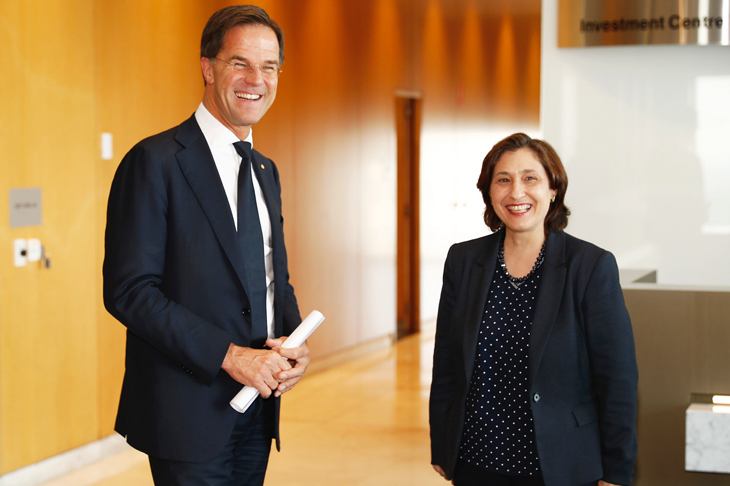
One of the strongest opponents of the inclusion of fossil fuels was Lily D’Ambrosio, the Victorian minister. But here’s the thing, the Victorian government is currently paying Energy Australia many millions of dollars (the exact figure is unknown, commercial-in-confidence you have to understand) to extend the life of the Yallourn brown coal plant in the Latrobe Valley. Now if that’s not a capacity mechanism without the name, I’m a monkey’s uncle.
Getting back to the lunatic decision taken by the NEM partners to institute a capacity mechanism excluding fossil fuels (including natural gas). In its place, weather-dependent intermittent renewable energy will be backed up by more weather-dependent intermittent energy plus a batch of batteries providing power for a few hours and possibly some pumped hydro (because Snowy 2.0 has been going so well).
It’s the equivalent of having a leaky bucket and thinking that another one will be helpful. Now most of us wouldn’t buy a washing machine or a fridge that works one third of the time. But if we did, we wouldn’t buy another equivalent washing machine or a fridge to back them up. It would be a pointless and expensive exercise.
Note here that the average capacity factor of variable renewable energy is around the one-third mark; at times, of course, the actual capacity factor is zero. In the normal course of events, the contribution of VRE is only part of total generation, with other sources, particularly coal and gas, ensuring that supply meets demand at all times.
Of course, there are variations over the course of a day and some days are windy while others are not. The perennial boast from the progressive press that renewable energy provided 100 per cent of a state’s power on certain days is actually a problem, not something to crow about. By undermining the business models of the generators that can fill the gaps by providing firmed power, the wild variations in renewable energy as a source of electrons create their own set of problems. There is also the issue of frequency stabilisation services which coal-fired plants provided gratis but now must be purchased.
The only way to understand the decision to exclude fossil fuels from a capacity mechanism – apart from appealing to the green illusions so many voters hold dear – is as a massive subsidy to grid-scale batteries. But there are some things that the advocates of this approach don’t want us to know about these batteries.
For one thing, they have a tendency to burst into flames. The one near Geelong did so and it created real problems for the fire brigade. We are not sure about their economic lifespans or the rate at which their efficiency falls. They are also still very expensive. Most importantly, they can only generate power for several hours rather than days before they need to be recharged. As a means of providing firmed electricity to cope with intermittent renewable energy, they have major limitations.
There are currently plans to construct a number of additional grid-scale batteries, bringing the total to ten. But these won’t touch the sides in terms of providing firmed power, particularly for long stretches of windless days. What they will do is generate huge profits for the owners by providing frequency services which were once provided incidentally.
The thing is we have much less to fear from climate change – after all, the human race has shown a massive capacity to adapt to new circumstances – than the lunatic policies dreamt up by ill-qualified politicians and their lackey advisers. There is so little appreciation of physics, engineering, and weather patterns – it’s truly scary.
Got something to add? Join the discussion and comment below.
You might disagree with half of it, but you’ll enjoy reading all of it. Try your first month for free, then just $2 a week for the remainder of your first year.