I recently returned from Saudi Arabia following an invitation by the Secretary General of the Muslim World League, Dr. Mohammed bin Abdul Karim bin Abdulaziz Al-Issa. The Muslim World League both hosted and financed all aspects of my travel and stay. It was over 12 years since I had last been to Saudi Arabia, 23 years since I once lived and practised medicine there. It is where I saw the 9/11 events unfold.
Landing in October, Riyadh was at once familiar and completely alien – the colossal development and new infrastructure in the last 23 years are astonishing. During my two-week stay, I moved freely in Riyadh, Jeddah, and the Two Holy Cities of Islam of which Saudi Arabia is custodian – Mecca and Medina – travelling the 300-mile distance between these ancient holy cities on the 190 mph Haramain high-speed rail carving its scimitar way through landscapes evoking T.E. Lawrence.
Profound though it was to once more worship in Mecca, it was speaking with Al-Issa as he described his mission and personal leadership across the Muslim world that most moved me.
Appointed by the Saudi monarchy, he has been serving as Secretary General to the League for more than six years. While the League received seed money from the Kingdom in 1962 at its founding, it now has its own autonomous budget and assets, headquartered in Mecca with a 60-member strong international Supreme Council. The council includes membership across diverse schools of Islamic thought and various sects of Islam. It is the voice, and very often the will of the Muslim ummah.
Internationally, Saudi Arabia suffered great reputational harm for human rights concerns as well as its tolerance and patronage of Islamism, forever branded with the legacy of Osama bin Laden and Al-Qaeda. Saudi Arabia had a key role in financing and propagating much of the ideology which infected madrasahs globally from Pakistan to Iraq where I have met with former child jihadists, and many others beyond. But when Islamist jihadism came home – launching the 2003 Al-Qaeda car bombings in Riyadh – the kingdom had a true epiphany.
The 2021 Carnegie Endowment details the changes ignited in Saudi Arabia that have been accelerated by Crown Prince Mohammed bin Salman. While the brutal 2018 murder of Jamal Khashoggi by Saudi agents still reverberates (even as the US guarantees sovereign immunity to the Crown Prince this week) there is no denying the remarkable impact of his leadership driving pluralism and true openness of Saudi society.
According to Carnegie, as early as 2006 under King Abdullah, the Saudi state police began arresting the religious police, sharply curtailing their power. By 2017 their last elements were removed from the public space.
King Abdullah saw reform of the judiciary and Islamic clergy as essential. Al-Issa was appointed minister of justice as part of these reforms, serving from 2009 until 2016, renewing the judiciary, packing court benches with non-extremist, pluralist and centrist Islamic jurists, advancing the legal system and expanding the recruitment of new legal minds and broadening legislative texts.
By 2015 Saudi Arabia had shuttered many religious NGOs for embezzlement, waste and defraudment of the Saudi public. Many dismantled NGOs had Islamist links, funding the Muslim Brotherhood (long designated as a foreign terrorist organisation by Saudi Arabia).
Having reformed the Saudi judiciary, in 2016 the monarchy (now ruled by King Salman) supercharged Al-Issa’s role as leader of the Muslim World League to advance pluralism globally.
Al-Issa has accepted the challenge. In January 2020 he became the most senior Muslim to have kneeled prostrate in prayer leading a Muslim delegation in worship at Auschwitz during the 75th anniversary of the allied liberation. Later in the same visit he led Friday Islamic prayers in Warsaw with Jewish people in attendance. For his remarkable interfaith dialogue, Al-Issa’s anti-pluralist critics label him a Zionist.
Al-Issa has hosted leading Christian clergy and Jewish rabbis in Saudi Arabia and has collaborated with evangelical Christians in the United States and American Jewish leaders, receiving both in Saudi Arabia. Recognising his remarkably pluralist and anti-extremist values, evangelical American clerics have asked he certify the training of all imams in America. (I asked him to certify imams preaching inside America’s prisons, often sites of radicalisation).
In 2017 Al-Issa met Pope Francis and signed a bilateral memorandum of understanding with the Catholic church, the first such agreement between the Muslim World League and the Vatican.
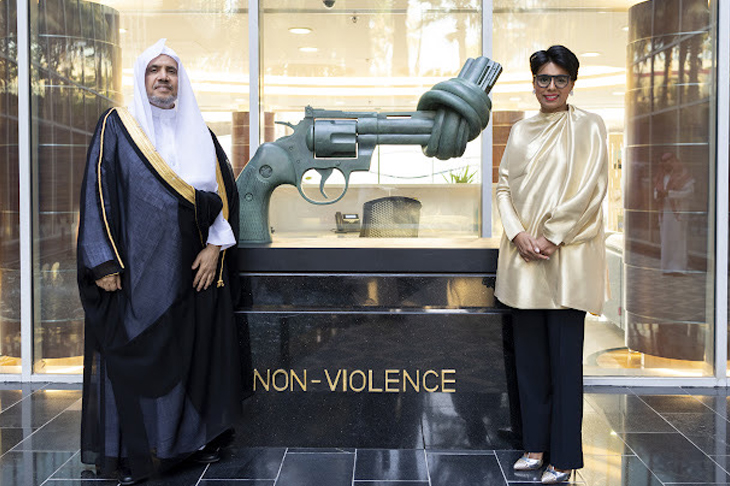
Al-Issa has hosted Buddhist and Hindu leaders in the kingdom and recently honoured Mahatma Ghandi on the international day of non-violence describing him as a ‘visionary, freedom fighter and follower of non-violence’.
Al-Issa has categorially and vocally delegitimised any use of violence in the name of Islam, including inside Israel. At his address from Mount Arafat at Hajj this year, the most revered sermon in the Muslim world,Al-Issa called for unity among Muslims and reminded them of Islam’s inherent humanitarian values incumbent upon Muslims.
Al-Issa’s Charter of Makkah was adopted in 2019 by 27 separate sects in Islam from 139 countries who unanimously endorsed it and made their signatories public. The charter is a code of commitment to promote true pluralist Islam, to best serve humanity and recognise all peoples are equal under God, a commitment to reject all claims of religious preference and prejudice and to accept that God revealed himself to all mankind and is the ‘origin of all religious belief in its various messages’.
Liberalising and forward thinking as Saudi Arabia has truly become, some offenses continue to carry the death penalty. This week the UN expressed concern as 17 people (including 7 Saudi citizens) were executed by beheading for capital crimes. However many other executions are stayed when relatives opt to accept blood money in lieu of execution – a right Islam gives only to victims’ families who may act as intercessors in sentencing for capital crimes. According to Islam not even the monarch himself may intercede when a capital crime has been committed – only the wronged relatives of slain victims may permit clemency in the face of the most egregious crimes.
I understand I was a guest of the Muslim World League and Saudi Arabia and that what I observed a cynic might consider ‘sanitised’. Yet I was free to speak to deeply trusted Saudi friends, Saudi strangers, Saudi professionals and others from all over the world surrounding me during worship, work and free time. My itinerary was mostly unstructured and unsupervised.
From what I witnessed, these new efforts in Saudi Arabia – vastly different from my experience living in the ultra-conservative Saudi Arabia of two decades ago – categorially demonstrate that the Kingdom is saving Islam from the Islamists.
Got something to add? Join the discussion and comment below.
Qanta A. Ahmed MD, is a Senior Fellow of the Independent Women’s Forum, Life Member of the Council on Foreign Relations and author of In the Land of Invisible Women: A Female Doctor’s Journey in Saudi Arabia. @MissDiagnosis
You might disagree with half of it, but you’ll enjoy reading all of it. Try your first month for free, then just $2 a week for the remainder of your first year.