Putin’s poker game
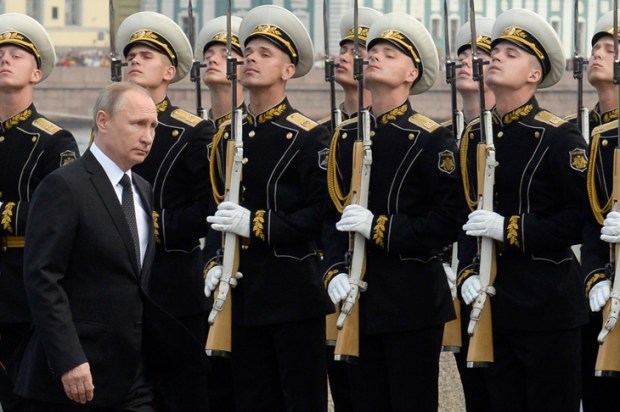
If the latest warnings of a Russian invasion of Ukraine prove right, you’ll be reading this as Europe’s greatest crisis since Hitler’s attack on Poland unfolds: Western intelligence leaks show an invasion planned for Wednesday February 16, using a false flag justification. ‘My guess is he will move in,’ was Joe Biden’s casual observation. Britain’s Defence Secretary Ben Wallace judges a Russian invasion ‘highly likely’.
In a conversation with French president Macron, Putin as usual has denied that he has any invasion plans, but also suggested Ukraine was planning its own attack on pro-Russian separatists. Further feeding the war speculation are reports that the Russian embassy in Kiev is evacuating staff.
But will Putin give the green light? One thing that wouldn’t deter him is the West’s shambolic diplomatic effort to avert a conflict – described by Wallace as having ‘a whiff of Munich’ about it. Western leaders talk of an invasion prompting ‘the mother of all sanctions’, but most of the threats so far will make Putin laugh rather than worry. The surely senile Biden has made it clear, astonishingly, that Putin would get away with anything less than full invasion. The US has since claimed that, if he invades, the completed Nordstream 2 gas pipeline, direct from Russia to Germany under the Baltic Sea, will never operate. But German Chancellor Scholtz won’t confirm the threat. His government has just closed a further three nuclear power plants, increasing already heavy reliance on Russian gas.
For his part Macron – probably the target of Wallace’s ‘Munich’ jibe – is playing Putin’s game by calling for implementation of the 2015 Minsk accord, which would reintegrate Ukraine’s two Russian-separatist-controlled regions but effectively give them, i.e. Putin, veto control over Kiev’s foreign policy.
US efforts to threaten a ban on Russian banks using the global Swift financial transaction system have been scuttled by European objections. Sanctions would target more Putin cronies than in 2014. But there’s no talk of a general ban on Russians travelling to the West. Russia’s mega-rich banned from their London properties and Riviera yachts would likely turn their anger on Putin if suddenly they were restricted to mini-breaks in Pyongyang or Minsk.
As is often said of Putin, he’s bad but not mad and it’s probably more likely that he’s playing a game of poker with the West rather than planning an invasion. That would be much uglier and more risky than the Soviet invasions of its rebellious satellites Hungary in 1956 and Czechoslovakia in 1968, whose populations quickly gave up resistance. It would look more like the Soviet quagmire in Afghanistan.
Ukraine would be no push-over. It’s Europe’s seventh-largest country by population and second-largest by area. It has about 250,000 active troops, with a further 900,000 reservists. Most adult males have at least basic military training. Russia could no doubt initially defeat Ukraine and instal a compliant government. But to successfully occupy the country and crush resistance would probably require many more than the 130,000 troops Putin has on Ukraine’s borders. Shorn of its most ethnically-Russian areas, Ukraine is mostly united behind a West-leaning future free of Russian dominance. Ukrainian resistance would be stiff and would be buoyed by Western military and political support and public sympathy.
If Putin were serious about attacking Ukraine, we’d expect him to be preparing Russians for the scale of the task and the inevitable casualties. But he isn’t. So what’s his game? He says he wants firm commitments that Ukraine will never join Nato and, absurdly, that Nato’s presence must vanish in all the countries on Russia’s ex-communist periphery – many now Nato members. In short, Putin wants acknowledgement that Russia has a right to a regional sphere of influence limiting its neighbours’ independence. Russia asserts that the West accepted this at the end of the Cold War but then ratted on the deal. The claim is based on a half-truth. In early 1990, President George H.W. Bush’s Secretary of State, James Baker freelanced on US policy, telling Gorbachev that Nato wouldn’t extend into the former East Germany after reunification. Moscow soon after accepted that all of Germany would be part of Nato.
And of course no US commitments were ever made about Nato not enlarging further east. The idea that the former captive nations, which endured monstrous Soviet tyranny and faced an unapologetic and still-menacing Russia under Putin’s rule, should have been told they couldn’t seek security in Nato because of Moscow’s sensitivities, would have been a profound betrayal of Western values. The genuinely broken solemn undertaking is the 1994 Budapest Memorandum, whereby Russia committed to respect Ukraine’s borders in return for its giving up the world’s third-largest nuclear arsenal, including 1,900 strategic nuclear weapons.
Why has this crisis emerged now? All of Moscow’s former European satellites, together with the Baltic States, had joined Nato by 2004. And Nato has had co-operative arrangements with Ukraine since 2008. But Moscow’s creation of contested territory there and in the other ex-Soviet Nato hopefuls, Georgia and Moldova, means they’ll never become members, even if Nato will never admit this. Russia is pushing on an open door.
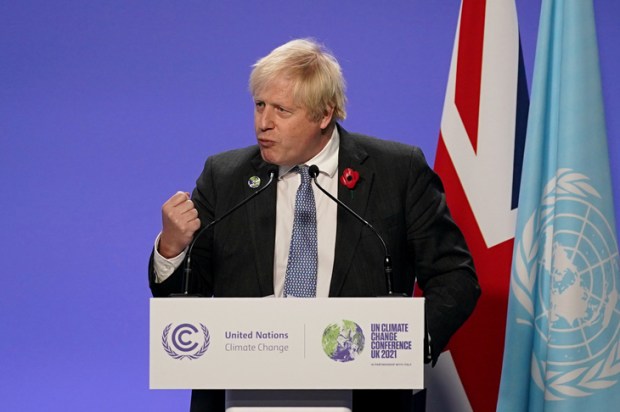
It’s probably no coincidence that Putin engineered the crisis having guaged particular Western weakness following the disastrous US flight from Afghanistan, the formation of Germany’s new government dominated by his best German friends, the Social Democrats, and maybe even the Johnson government’s recent descent into chaos.
Putin would probably present as a victory agreement by Kiev to implement the Minsk agreement and/or any assurance he can secure that Ukraine will never join Nato. That shouldn’t be too hard – new members require the unanimous agreement of the existing thirty. Either of these wins would also advance his perennial goal of sowing Western disunity. And – another bonus – if he gets his way and stands down the troops, he’ll be widely hailed as a man of peace.
Got something to add? Join the discussion and comment below.
Mark Higgie is The Spectator Australia European correspondent and was Australia’s ambassador to the EU and Nato.
You might disagree with half of it, but you’ll enjoy reading all of it. Try your first month for free, then just $2 a week for the remainder of your first year.