Unless you’re an expert, it often pays to keep quiet at the bridge table — something I really ought to remember. It shames me to think of all the times I’ve made a mistake and then tried to justify it, invariably using flawed reasoning which makes me look even more idiotic. That’s bad enough; but far worse are the times I’ve criticised my partner only to realise that I’m talking rubbish yet again: I’ve shown myself to be not just bossy, but bossy and wrong — not a great combination. At least I’m not the only one; we bridge players are quick to blame, and I’ve been at the receiving end plenty of times.
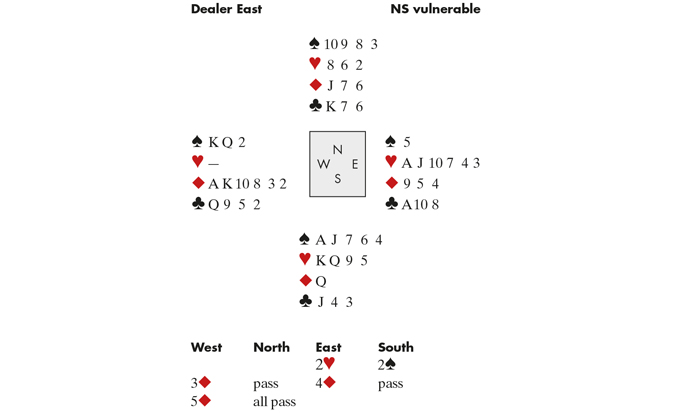
I played at the YC with Peter Taylor last Friday. He showed me this deal from the previous week; his partner had lectured him about his poor lead, but Peter is a superb analyst and was able to give as good as he got:
Peter (North) made an aggressive lead: a small club away from his king. Declarer played the ♣8 from dummy. South played the ♣J (unless he thinks his partner has led from KQx, he should really play low), and now declarer was able to finesse the ♣K: he ended up losing just a spade and a trump. Afterwards, the criticisms began: why didn’t Peter lead a spade? Peter pointed out that if South wins with the ♠A, declarer has discards for dummy’s clubs; if South plays low, declarer wins, ruffs two spades, and can play the clubs for one loser. Then you should have led a heart, said his partner. No: declarer wins in dummy and leads a spade, giving South the same losing options. Well, a trump lead would have broken his communications. Yes, a trump was probably best, agreed Peter — but if declarer ducks South’s ♦Q, South has no good return — so no lead whatsoever beats the contract!
Got something to add? Join the discussion and comment below.
You might disagree with half of it, but you’ll enjoy reading all of it. Try your first month for free, then just $2 a week for the remainder of your first year.