‘Let them eat cake,’ is the comment which is supposed to have guaranteed Marie Antoinette a seat on the guillotine express. It may be a tad soon to cite Tony Abbott’s reference to ‘lifestyle choices’ as an example of what the late Christopher Hitchens called the tumbrel remark. But it’s doubtful whether anything the Prime Minister has said or done in recent weeks has triggered more demands for his head. Telling the UN to stop lecturing Australia about how to deal with illegal immigrants probably got as many quiet cheers as loud boos, and while the bestowal of an anachronistic honour on an undeserving foreign toff was certainly a joke, it was, in the scheme of things, a fairly harmless one. But casually downplaying the serious health and welfare problems currently facing thousands of Australians can’t be laughed off. The Guardian’s Paul Dacre describes it as ‘Abbott’s third and final strike in Indigenous affairs’. He goes on to remind us what the other two strikes were and predicts that, should Tony Abbott ever be allowed to contest another election, he wouldn’t garner a single black vote. It’s not an unpersuasive argument. But just suppose for a moment that Abbott does somehow weather the current storm and retain the Lib leadership for another year or two. If Mr Dacre’s prediction came true, how much would it affect the outcome of that putative election? To put it another, more cynical way; is our leader’s apparently inexhaustible capacity to offend all his opponents, embarrass some of his allies, and infuriate large sections of the Australian media really just career madness? Or could there be some method in it?
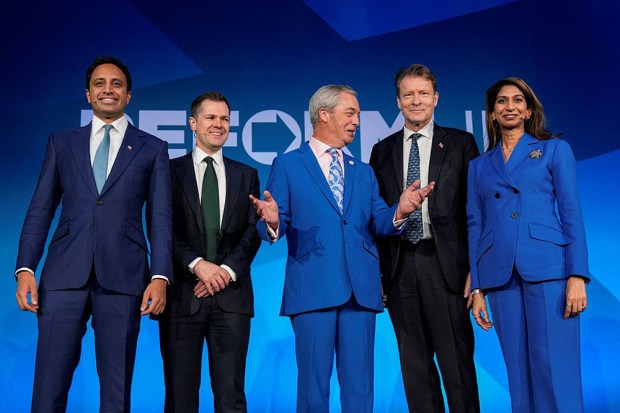
It’s not, after all, without precedent. 12,000 miles away, the leader of another political party has been making the same kind of statements about the same kind of issues, provoking the same kind of censure. And he’s been doing it for quite a lot longer than our Tony, too. But as readers of this magazine well know, nobody in the British Labour or Conservative parties (or the press for that matter) is saying that Nigel Farage won’t survive long enough to lead the United Kingdom Independent Party into the upcoming general election. Au contraire, for some considerable time now most of Farage’s opponents and detractors have reluctantly acknowledged that under his leadership Ukip could win enough seats in May to force one of the other parties to form a coalition government with it. In which case, far from ending up a Westminster footnote, its pint-drinking, fag-smoking, back-slapping leader will become 2IC of one of the world’s most influential economies. Yikes.
It’s hard to overstate what an achievement this would be. Ten years ago, the vast majority of poms viewed Ukip as a barely more respectable version of the discredited and now all-but defunct BNP, itself an offshoot of the openly neo-nazi National Front of the 1980s. To be fair, Farage himself was never a member of either organisation, and has gone to some trouble over the last couple of years to distance Ukip from their more extreme and unsavoury goals – even to the point of recently barring Ukip membership to anyone who was ever a member of BNP. But the two central themes of his manifesto – curbing immigration and extricating Britain from the European Union – have always provoked mutterings about apples not falling far from trees and lipstick on pigs. In fact for some time after Farage’s assumption of the party’s leadership in 2006 it would be fair to say he commanded the same kind of respect as Pauline Hanson did in Australia ten years before. One Nation’s position on immigration, after all, wasn’t all that different, and one can’t help wondering how much more seriously it might have been taken if, instead of allowing itself to be led by a self-immolating bobble-head, it had appointed someone as articulate and affable as Ukip’s leader. Newspapers like the Guardian still hate Farage with a passion, but when he walks down just about any British high street Nigel no-friends he most certainly isn’t. And the polls get better every day. So what has happened in Britain in the last twenty years to render what is still an essentially nationalist and still a potentially racist pitch that much more palatable to the average voter?
One answer, at the risk of stating the blindingly obvious, is that the average voter got twenty years older. And, unlike his or her parents, didn’t die. The same thing happened in Australia, and it’s not just because we also play cricket and eat lamb. The fact is, the fastest growing electoral demographic in most western countries today is not defined by race, gender, class or religion. In their single twenties and childless thirties many of these people were ideologically biddable – may even have marched along the odd street carrying a banner to make the world a fairer place. In their sixties and seventies, not so much. Faced with the prospect of decades of active retirement they now care more about things like healthcare, gym memberships and international travel. But despite having more to look forward to than their parents, they are dusting off the values of their parents’ generation. They look at their grandchildren and at the world they will inherit, and see all that is wrong with it, and remember how different things were when they were kids themselves. When it was easy to be nice to people who looked and sounded different to you, for example, because, well, there just weren’t that many of them. And when it was easy to find a job when you got out of school because, well, jobs weren’t that hard to find.
Nigel Farage’s 1950s values have struck a chord with the aging population like nothing offered by either of the main parties for a very long time. Tony Abbott’s latest gaffe, in which he compares his opposite number to Dr Goebbels – only weeks after accusing the Labor party of causing ‘a holocaust of job losses’ – is perhaps even more evocative of the post-war era, and seems aimed even more deliberately at voters with long memories.
In 1971 Australians aged 65 or over accounted for just under 8 per cent of the total population. Today that figure is closer to 15 per cent, and is set to rise substantially over the next ten years.
In 1888 the indigenous population of Australia was around 600,000. It still is. And that’s less than 3 per cent of the population.
It’s not rocket science, it’s democracy.
Got something to add? Join the discussion and comment below.
Simon Collins is a regular contributor to The Spectator Australia.
You might disagree with half of it, but you’ll enjoy reading all of it. Try your first month for free, then just $2 a week for the remainder of your first year.