Vale of Praise
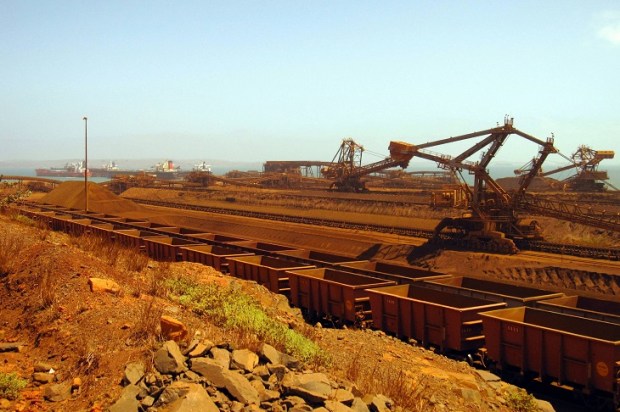
Sir: Michael Baume’s article on Iron Ore’s Vale of Tears (Business/Robbery etc 28 February) was the best I have seen on the subject in the Australian press. None of the ‘experts’ in Australia I have read to date have considered the fact of the extreme competition BHP Billiton and Rio Tinto face from the state owned Vale of Brazil. Rather they tend to concentrate, lazily, on the domestic rivalry of the two local producers. In addition to the freight aspect for China which will now favour Brazilian exports to China there is a technical advantage Vale has in the quality of their ore which is uniformly higher grade iron content, compared with Pilbara ore, and hence lower impurity content of phosphorus, in particular, alumina and silica. This quality difference is particularly attractive to many Chinese steel producers.
Basil Greene
Scarborough, WA
Disgusted
Sir: Jeremy Clarke’s Low Life article, 28 February in support of ‘the ancient and very wonderful sport of hare-coursing’ was upsetting. My friends in Year 6 and I are concerned at the practice of baiting grey-hounds with defenceless animals, in this case piglets, rabbits and possums which are strapped to mechanical lures and flung around a trial/training track. The idea of this is to increase the dogs’ prey drive, so that when they race, they will run faster and harder. We are trying to raise awareness about animal cruelty and keeping Eco-Friendly, so that our native possums are here for future generations. We are greatly disturbed and disgusted at what’s going on and want to make a difference.
Jemima Gray
St. Kilda, Victoria
A disaster for unionists
Sir: I share Alex Massie’s view that ‘this election is going to be a disaster’ for us unionists (‘Divided we fall’, 28 February). It is almost too painful to recall that it will mark the 60th anniversary of a great victory in May 1955 when the Tories, standing as Scottish Unionists, won more seats north of the border than their opponents and helped give Anthony Eden a secure majority. Under the baleful influence of George Osborne, who could not care less about the constitution, there seems little chance that the Tories will redeem themselves by proposing the one remaining policy that could save the Union: a new constitutional settlement for the UK based on the federal model. Osborne’s Tories are wholly preoccupied with their so-called long-term economic plan. A genuine long-term plan for the constitution ought to be the overriding priority.
Alistair Lexden
House of Lords, London SW1
Nationalists’ sham
Sir: If the SNP ends up as kingmaker at Westminster, the main parties have only themselves to blame. During the referendum campaign they refused to point out that the nationalist case was a complete sham. The SNP wanted Scotland’s currency to be controlled by London or Frankfurt, its passport to be an EU not a Scottish one, its Scottish system of law to be subordinate to European law, and the vast majority of its legislation to continue to originate in Brussels. But the press and the major parties refuse to deconstruct Scottish nationalism. Given The Spectator’s support of Britain remaining in the EU, what real difference does it make if Scotland has a separate presence there or if it is run from Brussels as part of a larger province called the UK?
Alan Sked
Professor of International History, LSE,
London WC2
Thanks to Goldsmith
Sir: Zac Goldsmith is absolutely right (‘My dad saved the pound’, 28 February). In 2000 I addressed 10,000 people in the pouring rain in Trafalgar Square, standing on the plinth of Nelson’s Column between the statues of two almost forgotten Victorian generals that Mayor Livingstone was urging should be replaced with memorials to more contemporary heroes.
If this were to happen, I suggested, one should be a small statue of John Major, for having negotiated an opt-out from the euro for Britain at Maastricht. The other should be a much larger statue of Sir James Goldsmith, for having prodded all the major parties in 1997 into pledging that Britain could not join the euro without a referendum. Not only did this ensure, I said, that Britain would never join the single currency; it would eventually be seen as the key to why Britain left the EU.
Christopher Booker
Litton, Somerset
Paolozzi preserved
Sir: Contrary to Stephen Bayley’s article on public art (Arts, 28 February), the preservation of the Paolozzi murals at Tottenham Court Road station is part of Transport for London’s upgrade work. Crossrail is constructing an entirely new station next to the existing one.
The preservation of artwork and the commissioning of new works are a major feature of the station upgrade. New artworks at the new Oxford Street entrance will eventually be joined by new pieces that will complement the iconic 1984 mosaic designs by Eduardo Paolozzi, an integral part of London Underground’s heritage. TfL has worked closely with the Paolozzi Foundation and design and conservation professionals to retain 95 per cent of the mosaics in their original locations.
The new Crossrail stations in London will also have large-scale artworks. The Turner Prize-winning artists Douglas Gordon and Richard Wright have, for example, recently been commissioned to install two new pieces of art at the Tottenham Court Road station.
Gareth Powell, Director of Strategy and Service Development, Transport for London
Julian Robinson, Crossrail Head of Architecture
Got something to add? Join the discussion and comment below.
You might disagree with half of it, but you’ll enjoy reading all of it. Try your first month for free, then just $2 a week for the remainder of your first year.