A rousing anthem strains the speakers as North Korea’s national carrier lands its nervous passengers at Pyongyang International [sic] Airport. The baggage carousel grinds like tectonic plates as we turn over our phones and books for inspection by men in clothing that hasn’t been updated since Brezhnev. The ubiquitous off-brown and proletariat blue canvas suits with short sleeves and oversized shoulder pads are to become a permanent stain on the retina.
Driving into central Pyongyang, we pass several military regiments marching along the road. “No photos!” scream our North Korean guides. Civilians too walk along the side of the road like stick figures, as though they were born without joints. “No photos!” Women sweep spotless gutters, while children and the elderly hand-clip the grass. “No –” OK, OK. In the town centre, attractive women in white uniforms stand in little circles at intersections and direct the trickle of traffic with batons. “OK to take photos.”
In the shadows of the paunchy bronze statues of Kim Il Sung and Kim Jong Il, we receive our first exposure to the DPRK shuffle. Women in their girl-guide suits and men in their Brezhnevs, school children in the national uniform with the perfectly folded red triangle scarf form cubes and move solemnly as one to bow. Afterwards, they step forward to place colourful bouquets of flowers at the base of the statues. It’s not until later when the crickets start up I realise the city is so damn quiet.
A hangover in North Korea is precisely the least amount of fun a human being can have. And so it went, after too much soju – or as a friend calls it, ‘felony juice’ – the next morning bleary eyes and unsteady feet are hauled to the mausoleum for endless reverential dips beyond the horizontal. We never quite master the forming of the cube. Later, we head to the top of the Juche Tower to see the Pyongyang skyline. A Legoland of regimented concrete greets us from every angle, reflecting the light to make the viewing even more uncomfortable. A lifeless brown river provides some relief. Tank-friendly boulevards are bereft of cars, as rusty bikes convey people and piled-high goods. Buildings closest to the roads are painted bright colours; the buildings behind rot.
The 100 metre ride down the escalator at Glory Station grimly reminds we Sydneysiders that even the North Korean government managed to build a metro. No doubt trying to replicate Stalin’s artistic turn in Moscow, the tunnels are lined with ugly watercolours of thrilled peasants. On the train, unthrilled peasants studiously avoid eye contact, other than a man fresh from a soju lunch who insists I sit next to him. On the platforms, people are greeted by the day’s newspaper in glass cases featuring but more pictures of the Korean War. Outside, a propaganda billboard – ending as always with an exclamation! – supervises an urban agrarian hand-tilling corn between train tracks.
“If there is another war we will defeat everyone so there is no one left to sign an armistice agreement. The table and chairs are original,” the Colonel explains without skipping a beat in the armistice room at the demilitarised zone, best known for being the most militiarised zone on earth. At the 38th parallel, where we can see South Korean check posts in the distance, even the UN flag has faded due to The Evil Imperialist Americans.
Back in Pyongyang, the twisting curves of the rollercoasters scattered around the outskirts of the city are a welcome contrast to the Soviet box architecture. We’re assured that the rides are Italian -made, which has the opposite effect on those of us who have experienced Italian transport. I wonder if they’re constructed specifically for the weight of North Koreans, said to be some five inches shorter than the average South Korean. A couple of shots of soju later, we’re strapped in horizontally, viewing the skyline like Superman.
The days, like the Kims, begin to blend into each other. We are taken to the library, where one of them provided “on-the-spot guidance” in the construction and fit out of the monstrosity. A tinseled attempt at a chandelier on closer inspection shows lights flickering underneath, fighting for power like the rest of the country. We are proudly shown the two computers with the North Korean intranet, before being taken into the music appreciation room, where rows of dusty ghetto-blasters are lined up on desks, one playing Madonna’s American Pie.
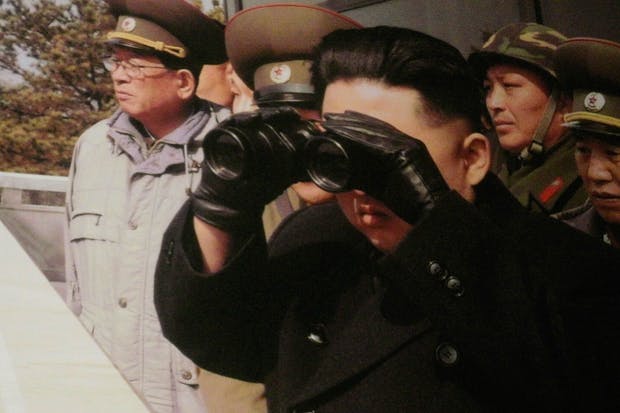
By the time we reach Arch of Triumph – “like the French one but bigger” – I long to refuse to get off the bus. I even feel a twinge of sympathy for Kim Jong Un: looking at things all day is boring. We begin to share our fantasies of our first meal on the outside, or going for a walk alone. While we’re all sending each other insane by humming the same traditional welcome song sung to us at every meal, an American yells “I think I saw a piece of trash!”
Evil is banal as hell, and the road there is unpaved. My first stop outside is a second-rate Chinese industrial town which seems positively cosmopolitan. Across the river, North Korea sits in darkness. But the worst thing is that there is so little new to say: we already know of the horror in detail; the only light is the absurdity. And my, I’ll miss the beer. It’s really, really good.