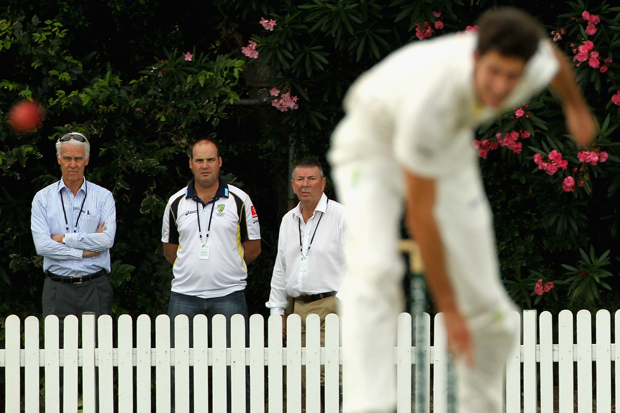
Of all the sights of Australia’s long phase of cricket dominance, none was quite so characteristic as Ricky Ponting emerging to bat at the fall of the first wicket. His was a team full of brilliant virtuosi, each with their own airs and auras. Yet somehow Ponting’s arrival proclaimed most clearly their collective purpose: he strode from the gate as though he couldn’t wait to get to grips with his opponents; if the first ball was anywhere near straight, it was four off the pads; dropped short, it would be hooked; pushed wide, it would be driven. Every shot burst with ambition and enterprise. Over a long peak he accumulated Test and one-day hundreds as effortlessly as a mogul minting millions.
Now they’re both over: the seemingly endless summer of Australian success and, at last, Ponting’s part in it. He stayed beyond his peak, perhaps some years, so that his diminishing effectiveness appeared to act as a kind of leading indicator of overall decline. His official testament, At the Close of Play, is massive, slablike, gilt-inscribed — the qualities, in fact, of a tombstone, which it sort of is, at least for the era, if not for Australian cricket itself.
At the Close of Play is actually Ponting’s tenth book; that’s to say that another nine, including eight tour diaries, have borne his name. Those books and this work are distinguishable, but perhaps not as profoundly as they should be, sharing the ghost writer of many of them, Geoff Armstrong. Perhaps as a result, the chronological recitation of stories sounds a bit familiar, a tad routine.
Attempts to leaven the progress with pages on darker stock dedicated to issues like ‘Coaching’ and ‘Leadership’ feel perfunctory. When Ponting/Armstrong starts talking about ‘Planning’ in terms of ‘vision, values and validation’, you can’t escape sensing the honing of a shtick for a retirement career addressing corporates. Some chapters are thrown together, and others deadened by repetition, while editorial slackness has permitted such sentiments as: ‘It is impossible to underrate how important it is to effectively manage players’ workloads.’ Yet if Australian cricket’s long heyday doesn’t lend itself readily to light and shade, At the Close of Play has two arresting features: the narrations of the subject’s rise and decline.
There is sincere feeling to the chapters describing Ponting’s upbringing, in the bosom of his family, his town of Launceston and his club of Mowbray. The Mowbray Eagles, Ponting reports with relish, were a hard team, arch competitors, feared opponents — rather like Australia in their pomp. Yet to the precocious charge in their midst ‘they were kind and generous men’, especially club coach Ian Young. The stalwart Aussie clubman in his ‘King Gee work pants, steel-capped boots and big flannelette shirt’, Young devoted himself body and soul to helping Ponting fulfil his potential, asking nothing in return. ‘As long as I worked hard, greeted him with a firm handshake and looked him straight in the eye and listened when he spoke,’ Ponting remembers, ‘that was all he wanted.’ In his understated but heartfelt way, Ponting presents a moving portrait of working-class Australia, social mobility provided by his prowess. ‘Sport was the making of me,’ he says.
In describing big cricket, Ponting is then refreshingly candid about his vulnerabilities and anxieties. It was harder, he wants us to know, than it looked. The star team he joined was perhaps not quite so inclusive as Mowbray: ‘The attitude of the team’s leadership group in those days was basically: Work it out for yourself. Maybe that’s not a bad thing with some young blokes, because it breeds a resilience that can be important when tough times occur later, but I think a few promising players in the 1990s would have appreciated more mentoring.’ To be true, Ponting never looked other than a player well and truly capable of looking after himself. But in hindsight, he steers us towards an unexpected conclusion: that what finally gets the better of a cricketer is not time, or age, or reflex, but the fading capacity to fight back.
From early setbacks, Ponting rebounded irrepressibly. ‘I’m going to go back to state cricket and get a hundred every time I bat,’ he told himself, and virtually did. Then in India in 2001 he experienced a watershed. He describes with candour taking guard at Mumbai chock full of confidence to a bowler, Harbhajan Singh, of whom he had no fear, and succumbing at once to a turning, spitting off-break. ‘As I walked off,’ he recounts, ‘I was in something of a daze, with the same thought going around in my head: I did everything right but I got out. In one ball, the faith I had in my technique was shattered.’
The thought kept recurring: I did everything right, but I got out. Though seniors told him to ‘back himself’, he could not feign what he did not feel: ‘In the circumstances, they were mere clichés.’ For a time, his batting powers deserted him. And while he made many more runs, it is almost as if having known the sensations of batting disarray, he was bound to experience them again. Facing a fearsome South African attack last summer, he again found himself walking off ‘in a daze’, except that this time he told his wife: ‘I’m not sure I can do this any more. I don’t think I can keep putting myself through it.’
As he says: ‘I had heard sports psychologists talk about the ‘little voice’ that sits on athletes’ shoulders as they compete. It’s a negative voice, one that says you’re no good, that you can’t win, that’s it not worth it, that you should give up. The great athletes are able to ignore that little voice, or tell it to go away… I couldn’t get rid of the little bastard at the end.’ It’s a humble, honest and entirely characteristic admission.
Got something to add? Join the discussion and comment below.
Gideon Haigh is author of 29 books. His latest, Uncertain Corridors: Writings on Modern Cricket is published in two weeks.
You might disagree with half of it, but you’ll enjoy reading all of it. Try your first month for free, then just $2 a week for the remainder of your first year.